
Introduction
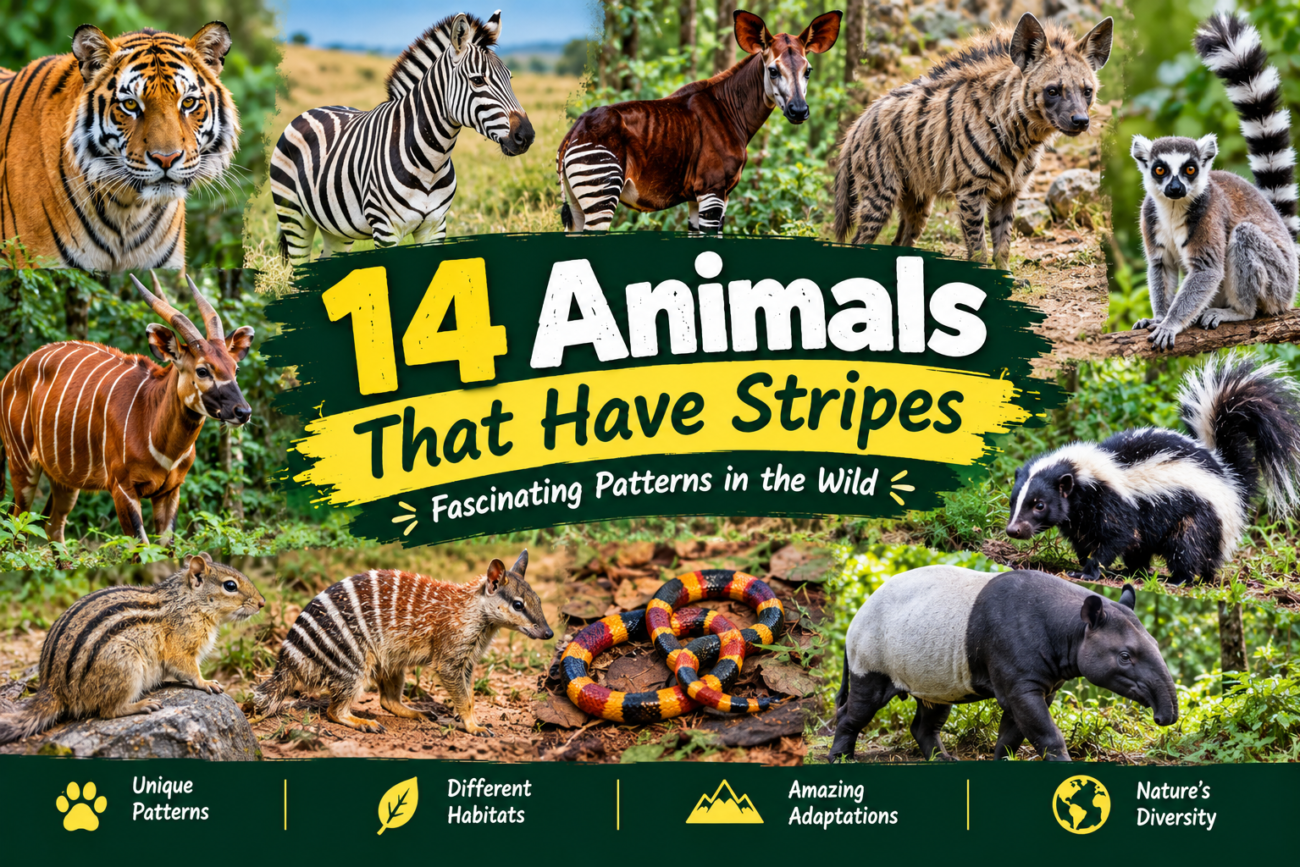
Nature uses patterns in countless ways, and stripes are among its most recognizable designs. A tiger’s dark bands, a zebra’s bold black and white coat, and the narrow lines on a chipmunk may look quite different, but each makes its animal instantly recognizable. Stripes appear across several animal groups, including mammals and reptiles, and vary in color, width, direction, and placement.
The phrase animals that have stripes covers species with very different lifestyles. Some live in dense forests, others roam open grasslands, and some spend their lives underground or in tropical habitats. Their markings may help break up their outline, provide warning signals, or simply be part of a distinctive coat pattern. Scientists do not assume that every stripe has the same function, and some explanations remain under investigation.
In this guide, we explore 14 striped animals, including their scientific names, diets, habitats, and interesting traits. You’ll also learn why stripes matter and why their purpose depends on the species.
Quick Answer: What Animals Have Stripes?
Animals that have stripes include striped hyenas, thirteen lined ground squirrels, bongos, striped skunks, okapis, zebras, chipmunks, numbats, striped mice, tigers, greater kudus, ring tailed lemurs, coral snakes, and Malayan tapirs. Their patterns range from narrow lines to bold bands, and their functions vary by species and environment.
1. Striped Hyena
Scientific Name: Hyaena hyaena
Class: Mammalia
Diet: Omnivorous; scavenges and eats animal and plant matter
Habitat: Dry grasslands, scrublands, rocky areas, and semi deserts
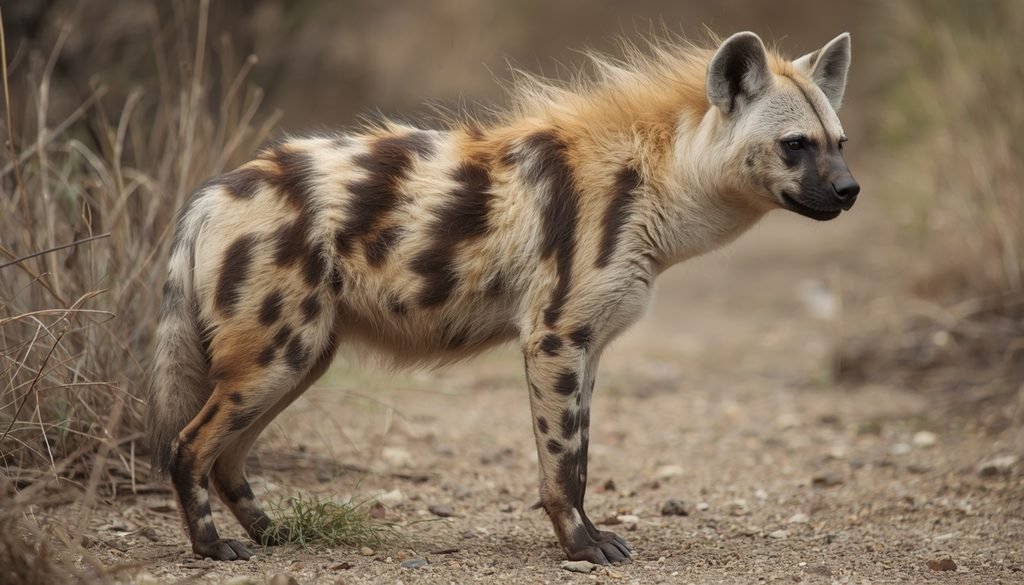
The striped hyena has a pale gray or sandy coat marked with dark vertical stripes on its sides and legs. A long mane runs along its back and can become more noticeable when the animal feels threatened. Compared with the spotted hyena, this species is generally more solitary and often forages at night.
Its diet includes carrion, small animals, insects, fruit, and other available food. Its stripes create a distinctive appearance, but their precise function should not be assumed to be the same as the markings of other striped mammals. Its adaptable feeding habits help it survive in a range of dry environments.
2. Thirteen Lined Ground Squirrel
Scientific Name: Ictidomys tridecemlineatus
Class: Mammalia
Diet: Omnivorous
Habitat: Prairies, grasslands, open fields, and short grass areas of central North America
The thirteen lined ground squirrel is a small mammal with alternating light and dark stripes running lengthwise along its back. Some of the pale lines contain rows of small spots, giving the animal a patterned appearance. It lives in open habitats where it can dig burrows and quickly retreat underground when danger approaches.
Its diet includes seeds, grasses, insects, and other small food items. The striped coat may help break up its outline among grasses and patches of soil, although the exact role of the pattern is not established for every situation. This ground squirrel is also known for seasonal activity, spending colder periods in underground retreats.
3. Bongo
Scientific Name: Tragelaphus eurycerus
Class: Mammalia
Diet: Herbivore
Habitat: Dense tropical forests of Central and West Africa
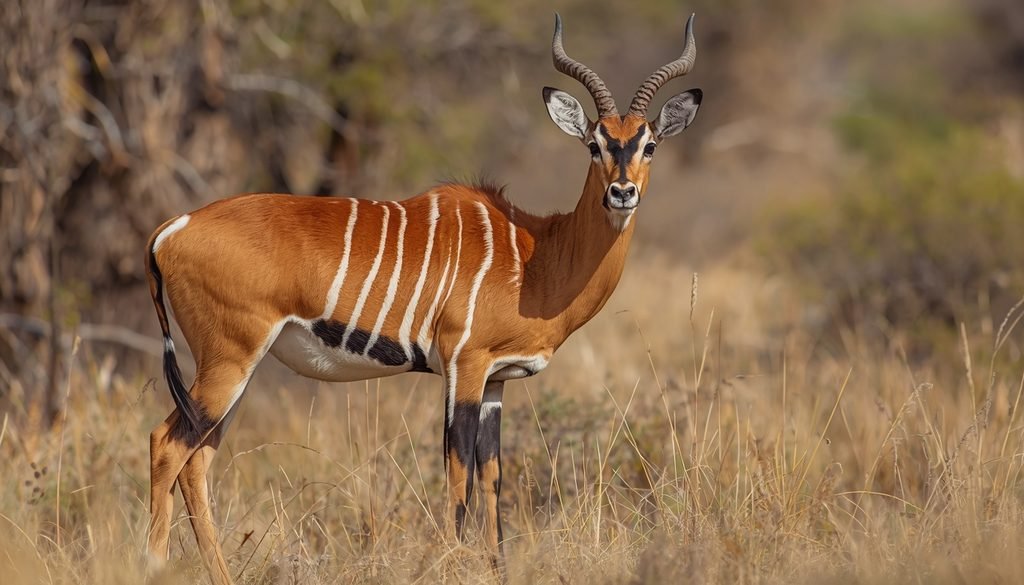
The bongo is a large forest antelope with a reddish brown coat crossed by narrow white vertical stripes. It also has large ears and, in males and females, long spiral horns. Its striking markings contrast with its rich coat color, making it one of Africa’s most distinctive forest mammals.
Bongos browse on leaves, shoots, and other vegetation. They are often difficult to spot in dense forest, where thick plants and filtered light create a visually complex background. Their stripes may contribute to blending into this environment, but camouflage should be treated as a possible function rather than a proven explanation for every marking. Bongos are generally secretive and rely on cover to avoid danger.
4. Striped Skunk
Scientific Name: Mephitis mephitis
Class: Mammalia
Diet: Omnivorous
Habitat: Woodlands, grasslands, farmland, and suburban areas across North America
The striped skunk has a black coat with two prominent white stripes that usually extend from the head along the back. Its bold contrast is often described as warning coloration: it makes the animal conspicuous rather than hiding it. Skunks have a powerful defensive spray produced by glands near the base of the tail.
A skunk generally prefers to avoid conflict. It may raise its tail, stamp its feet, or turn its back as warning behavior before spraying. Its diet includes insects, small animals, fruit, and other available foods. The stripes are associated with its recognizable warning appearance, while the spray is a separate defensive adaptation.
5. Okapi
Scientific Name: Okapia johnstoni
Class: Mammalia
Diet: Herbivore
Habitat: Tropical rainforests of the Democratic Republic of the Congo
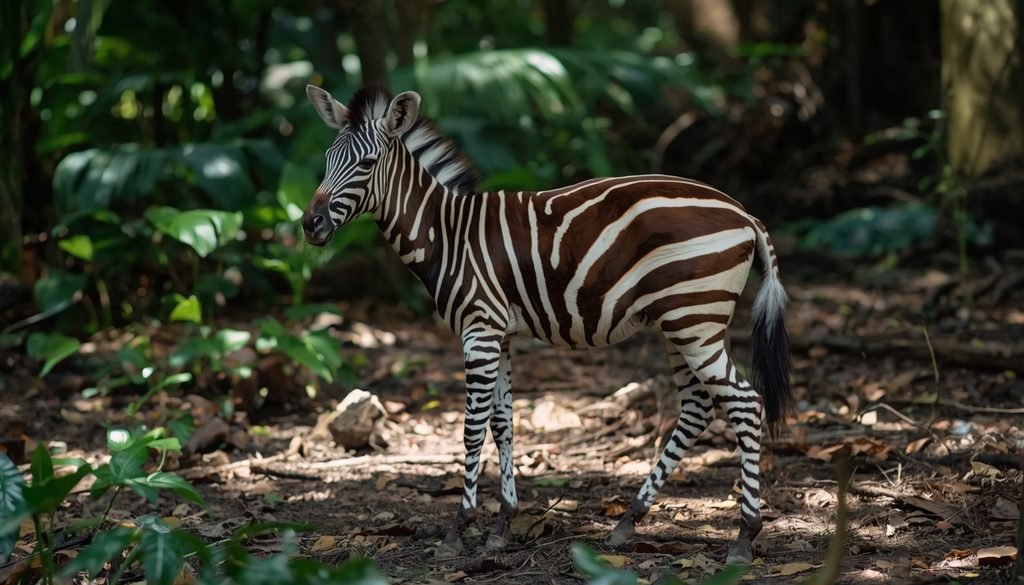
The okapi has a dark reddish brown body and striking white markings on its hindquarters and legs. These zebra like stripes make it easy to recognize, but the okapi is actually more closely related to the giraffe than to zebras. It has a long neck, large ears, and a flexible tongue used to gather leaves and other vegetation.
Okapis live in dense Central African rainforest, where sunlight filters through the canopy in broken patches. Their markings may help disrupt the outline of the body in this environment. The San Diego Zoo describes the stripes as useful camouflage in partial sunlight and notes that they may also help young okapis follow their mothers.
6. Zebra
Scientific Name: Equus quagga (plains zebra)
Class: Mammalia
Diet: Herbivore
Habitat: African savannas, grasslands, and open woodland
Zebras are among the most familiar animals with stripes. Their coats feature bold black and white patterns, with individual variation in stripe width and arrangement. Plains zebras live in social groups and graze on grasses, often moving across open habitats in search of food and water.
Scientists have proposed several explanations for zebra stripes, including camouflage, visual effects, social functions, temperature related effects, and reducing contact with biting flies. Research has found evidence supporting an association between striping and biting fly pressure, while other proposed explanations have received less consistent support in some analyses. The full story remains an active scientific topic.
7. Eastern Chipmunk
Scientific Name: Tamias striatus
Class: Mammalia
Diet: Omnivorous
Habitat: Deciduous forests, woodland edges, gardens, and rocky areas in eastern North America
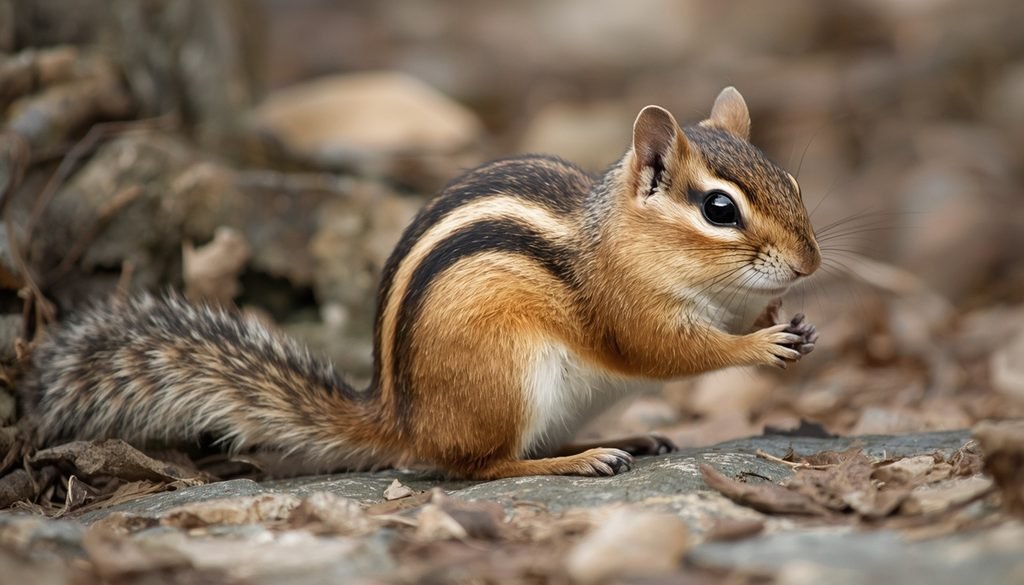
The eastern chipmunk is a small, quick moving rodent with dark and pale stripes running along its back. Its facial stripes make its appearance especially distinctive. Chipmunks use cheek pouches to carry seeds and other food, which they may store in underground burrows.
They eat seeds, nuts, berries, fungi, insects, and other small food items. Their stripes may help break up their outline as they move through leaf litter, grass, and woodland shadows, although this should not be treated as the only purpose of the pattern. Chipmunks spend much of their time foraging and staying alert to predators.
8. Numbat
Scientific Name: Myrmecobius fasciatus
Class: Mammalia
Diet: Insectivore, primarily termites
Habitat: Eucalypt woodlands and dry forests of southwestern Australia
The numbat is a small marsupial with reddish brown fur and several white transverse bands across its back and rump. Unlike many mammals that are active at night, numbats are mainly active during the day, when they search for termites. Their long, narrow snout and sticky tongue help them collect this food.
Numbats do not have the strong digging claws of many termite eating mammals, so they often feed at exposed or shallow termite galleries. Their stripes create a striking pattern across the back, though their exact role should not be overstated. Numbats are a specialized Australian mammal and are distinct from true anteaters.
9. Striped Mouse
Scientific Name: Rhabdomys pumilio
Class: Mammalia
Diet: Omnivorous
Habitat: Southern African grasslands, scrublands, rocky areas, and open habitats
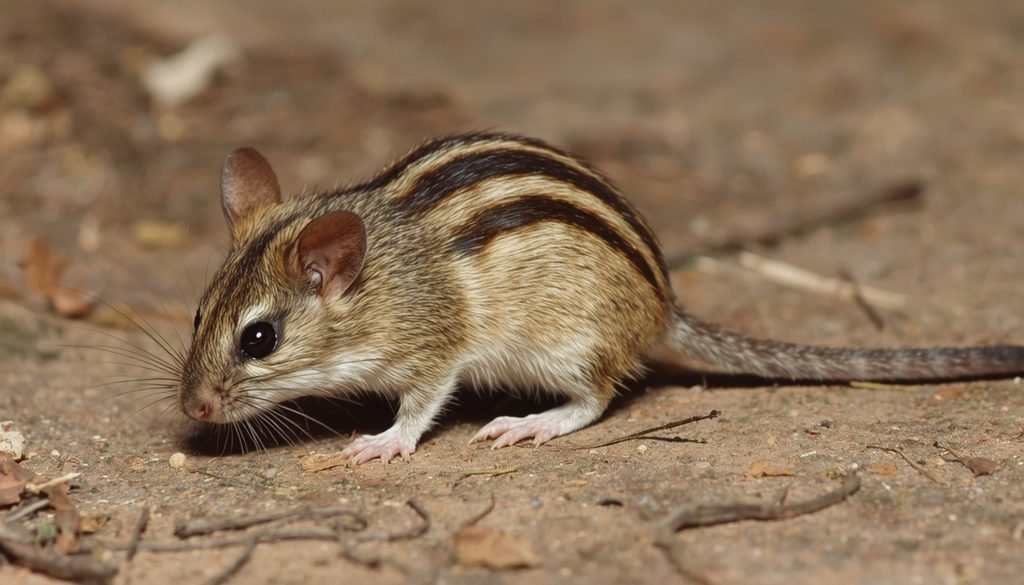
The striped mouse has several dark longitudinal stripes running along its back, separated by lighter bands. This pattern makes it easy to distinguish from many other small rodents. It occurs across parts of southern Africa and can inhabit environments ranging from grassland to shrub covered terrain.
Its diet includes seeds, plant material, and small invertebrates, depending on local availability. Striped mice are active foragers and use shelter to avoid predators and harsh conditions. Their coat pattern may help visually break up the body against vegetation or uneven ground, but the function of the stripes should not be presented as fully established. Their survival also depends on alertness, shelter, and access to food.
10. Tiger
Scientific Name: Panthera tigris
Class: Mammalia
Diet: Carnivore
Habitat: Asian forests, grasslands, mangroves, and other suitable habitats
A tiger’s orange coat is marked with dark vertical stripes that continue along its body and limbs. The pattern varies among individuals, and the stripes are also visible on the skin beneath the fur. Tigers are solitary predators that often rely on stealth when approaching prey.
In forests and areas with tall vegetation, the contrasting pattern can help break up the tiger’s outline among shadows, stems, and patches of light. This is commonly described as disruptive coloration. Tigers also use hearing, smell, strength, and careful movement when hunting; stripes are only one feature of their adaptation to their environment.
11. Greater Kudu
Scientific Name: Tragelaphus strepsiceros
Class: Mammalia
Diet: Herbivore; primarily a browser
Habitat: African savannas, woodland edges, and scrub habitats
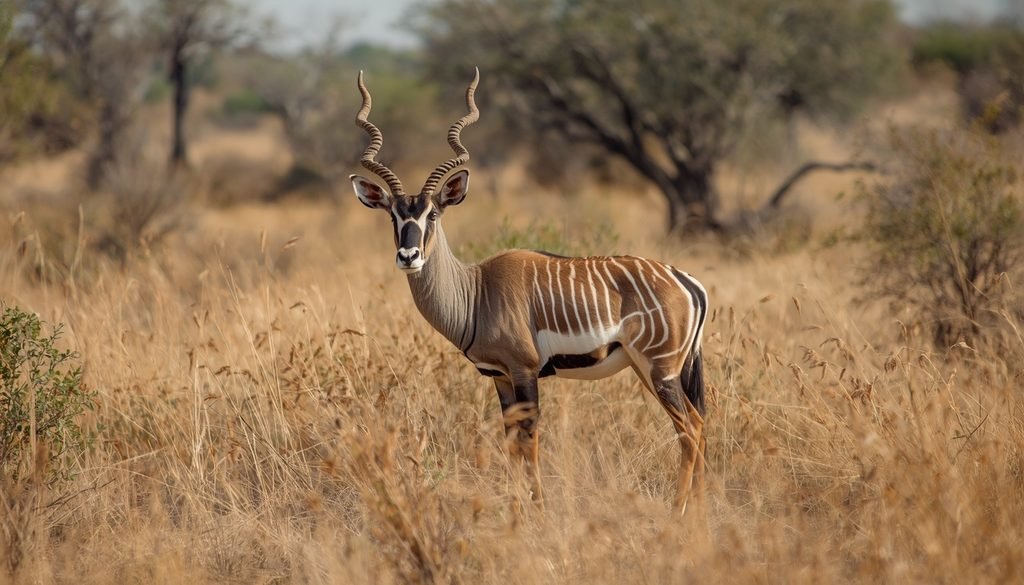
The greater kudu is a large antelope with a gray brown coat and several thin white vertical stripes along its sides. Males have long spiral horns, while both sexes have large ears that help them detect sounds. Their coat markings create a distinctive pattern against the animal’s body.
Greater kudus browse on leaves, shoots, and other vegetation, often feeding among shrubs and trees. Their stripes may help soften the animal’s outline in broken light and vegetation, although the precise contribution of the pattern varies with habitat and conditions. When disturbed, kudus may remain still or move quickly into cover.
12. Ring Tailed Lemur
Scientific Name: Lemur catta
Class: Mammalia
Diet: Omnivorous
Habitat: Dry forests, scrublands, and rocky areas of Madagascar
The ring tailed lemur is famous for its long tail marked with alternating black and white rings. Unlike the body stripes of a tiger or zebra, these markings are arranged around the tail. Ring tailed lemurs live in social groups and spend time both on the ground and in trees.
Their diet includes fruit, leaves, flowers, and other plant material, with occasional animal foods. They communicate through scent, vocalizations, and body movements. The contrasting tail is a recognizable visual feature, but it should not automatically be described as camouflage or a specific signal without evidence. Their social lives and adaptations are shaped by Madagascar’s varied habitats.
13. Eastern Coral Snake
Scientific Name: Micrurus fulvius
Class: Reptilia
Diet: Carnivore; primarily small reptiles and other small animals
Habitat: Pine flatwoods, scrub, wooded areas, and sandy habitats in the southeastern United States
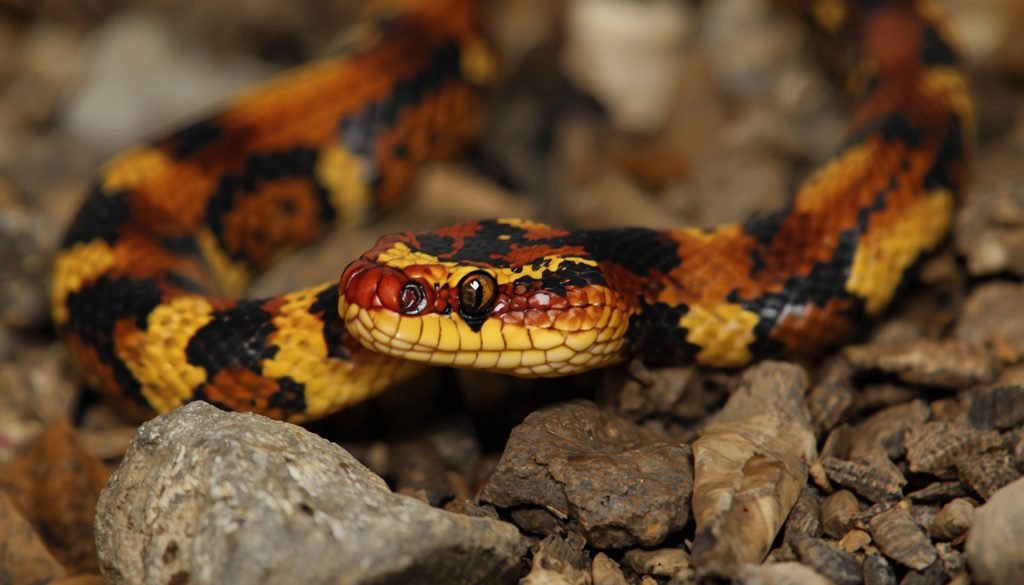
The eastern coral snake has a striking pattern of red, yellow, and black bands. Its bright coloration is associated with warning coloration, which can signal that the animal is dangerous to potential predators. Coral snakes are venomous, and their small size does not make them safe to handle.
They feed mainly on other snakes and small reptiles, using venom to subdue prey. Coral snakes are often secretive and may spend time beneath leaf litter, logs, or other cover. Because band patterns can be confusing across different snake species, people should never identify a wild snake by a quick glance or attempt to pick it up.
14. Malayan Tapir
Scientific Name: Tapirus indicus
Class: Mammalia
Diet: Herbivore
Habitat: Tropical forests and swamp forests of Southeast Asia
The Malayan tapir has one of the most unusual color patterns among large mammals. Its front half and hindquarters are mostly black, while a broad pale band covers the middle of its body. This is not a set of narrow stripes, but the strong contrast creates a distinctive patterned appearance.
Malayan tapirs are plant eaters that browse on leaves, shoots, and fallen fruit. They live in forests where shade, vegetation, and low light shape their daily activity. The contrasting coat has been proposed to help disrupt the animal’s outline in forest conditions, but it is best described as a possible advantage rather than a confirmed single purpose. Tapirs are generally shy and avoid people.
Why Do Animals Have Stripes?
Stripe patterns can have several possible functions, and their importance differs from one species to another. In some animals, contrasting markings may help break up the body’s outline, making it harder to distinguish against complex backgrounds. This is often called disruptive coloration. Other patterns are conspicuous and may serve as warning coloration, as seen in the striped skunk and eastern coral snake.
The role of zebra stripes has received particular scientific attention. Researchers have investigated camouflage, predator related effects, social functions, heat management, and biting fly avoidance. A comparative study found support for associations between striping and biting fly pressure, while other hypotheses received less consistent support in its analyses. Later reviews continue to discuss multiple possible explanations.
Patterns may also arise through evolutionary history and may have more than one effect. It is therefore inaccurate to claim that all striped animals use their markings for the same purpose.
Read More: 15 Dirtiest Animals in the World
Final Thoughts
The animals that have stripes show just how varied nature’s patterns can be. From the tiger’s dark bands and the zebra’s contrasting coat to the okapi’s striped legs and the ring tailed lemur’s banded tail, these markings appear in many forms and habitats.
Some patterns may help animals blend into their surroundings, while others are linked with warning coloration or have functions that scientists are still investigating. Stripes are not a one purpose adaptation shared by every species. By learning about each animal’s habitat and behavior, we can better appreciate the diversity of wildlife and observe it responsibly. Which striped animal surprised you most?
FAQs
1. What animals have stripes?
Striped animals include tigers, zebras, okapis, bongos, striped skunks, striped hyenas, chipmunks, numbats, striped mice, greater kudus, ring tailed lemurs, coral snakes, and Malayan tapirs. Their patterns differ in color, shape, placement, and possible function.
2. Why do animals have stripes?
Stripe patterns may help with camouflage, disruptive coloration, warning signals, or other species specific functions. Their role depends on the animal and its environment. Scientists continue to study some patterns, especially the black and white stripes of zebras.
3. Which animal has the most recognizable stripes?
Zebras are among the most recognizable striped animals because of their bold black and white coats. Tigers are also famous for their dark stripes on orange fur. Each species has a distinctive pattern, and individual animals can show variation.
4. Are zebra stripes used for camouflage?
Camouflage has been proposed as one possible explanation, but it is not the only hypothesis. Research has also examined biting fly avoidance, predator related effects, social functions, and temperature related explanations. Evidence differs across hypotheses, so no single explanation should be treated as universally settled.
5. Do all striped animals use their patterns for protection?
Not necessarily. Some markings may help conceal an animal or warn predators, but the function is not known for every species. Patterns can also reflect evolutionary history or have several effects. Avoid assuming that every stripe evolved for the same reason.
6. Are coral snakes with stripes dangerous?
Eastern coral snakes are venomous and should never be touched or approached. Their red, yellow, and black bands are distinctive, but snake identification can be difficult. If you encounter a snake in the wild, keep your distance and allow it to move away.

One thought on “14 Animals That Have Stripes: Fascinating Patterns in the Wild”