
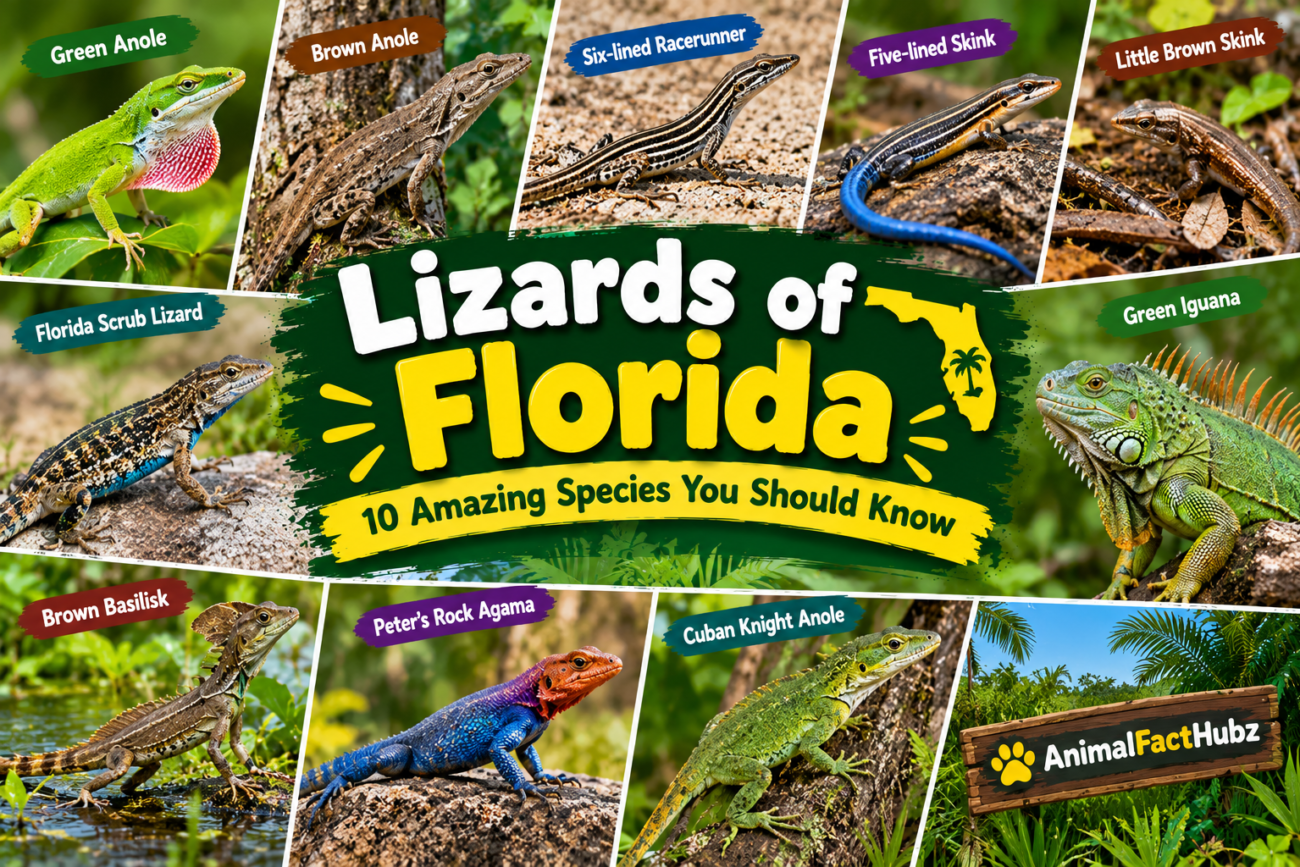
Florida is home to a remarkable variety of lizards, from tiny skinks hiding beneath fallen leaves to colorful anoles climbing garden walls. Warm weather, abundant insects, forests, wetlands, sandy habitats, and residential neighborhoods allow many species to survive across the state. Some lizards are native to Florida, while others arrived from different parts of the world and established wild populations.
Learning to recognize the lizards of Florida can help you understand local wildlife, distinguish native species from introduced ones, and appreciate the roles these reptiles play in the ecosystem. Although many Florida lizards are harmless to people, certain nonnative species can affect native wildlife and natural habitats.
Quick Answer: What Lizards Live in Florida?
Common lizards found in Florida include the green anole, brown anole, six-lined racerunner, southeastern five-lined skink, little brown skink, Florida scrub lizard, green iguana, brown basilisk, Peter’s rock agama, and Cuban knight anole. The green anole, six-lined racerunner, southeastern five-lined skink, little brown skink, and Florida scrub lizard are native species. Several others are introduced, and some can become invasive. Florida’s lizards occupy habitats ranging from forests and scrublands to gardens, buildings, canals, and urban parks.
1. Green Anole (Anolis carolinensis)
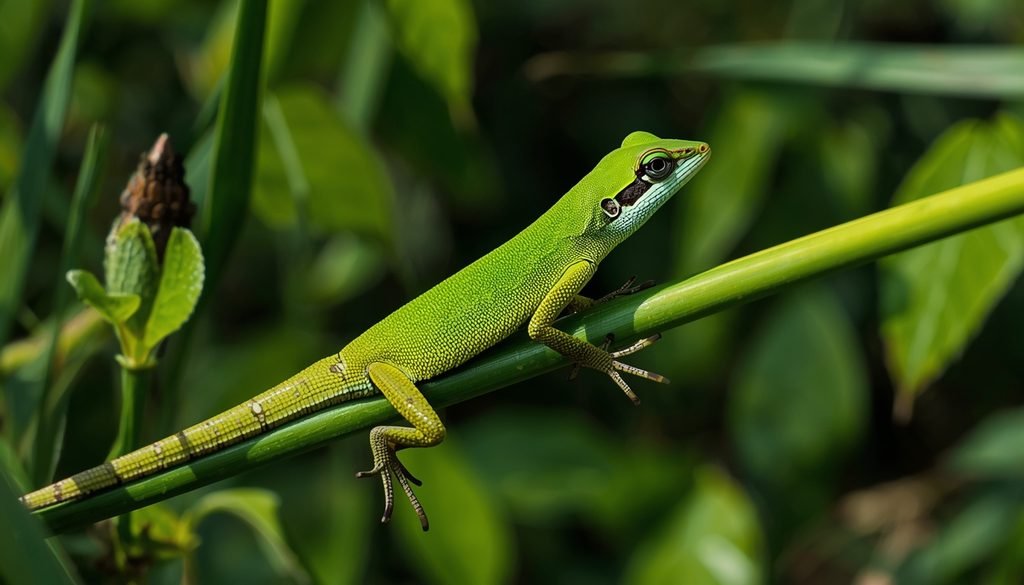
The green anole is one of Florida’s best-known native lizards. Often spotted on shrubs, fences, tree trunks, and porch railings, this small reptile is especially common in warm, vegetated neighborhoods. Its slender body, pointed snout, and adhesive toe pads make it well suited to climbing.
Appearance and identifying features
Green anoles are usually bright green, but they can change to brown or gray depending on conditions such as temperature, stress, and surroundings. This ability sometimes leads people to mistake them for true chameleons, although green anoles belong to a different group of lizards.
Males have a colorful throat fan called a dewlap, which they extend during courtship and territorial displays. In much of Florida, this fan is pinkish.
Habitat and diet
Green anoles inhabit trees, bushes, woodland edges, gardens, and other places with suitable vegetation. They eat insects and other small invertebrates, helping limit the numbers of some garden pests. Because they are relatively small, they must also watch for birds, snakes, and larger lizards.
2. Brown Anole (Anolis sagrei)
The brown anole is among the lizards Floridians are most likely to encounter around homes and businesses. Despite its familiar presence, it is not native to Florida. This species originated in the Caribbean and became established in the state after arriving through human-associated transport.
How to recognize a brown anole
Brown anoles typically have tan, brown, gray, or nearly black coloring, often with darker markings along their backs. Males can display an orange-red throat fan with a yellow border. They do not turn green like native green anoles, making body color alone a useful—but not infallible—identification clue.
Where it lives and what it eats
These adaptable lizards thrive on the ground, around tree trunks, in landscaped yards, and beside walls and sidewalks. Their diet consists largely of insects and other small invertebrates.
Brown anoles can compete with native lizards for food and space. Their ecological effects vary by location, but their widespread presence makes them an important part of any guide to Florida’s introduced reptiles.
3. Six-Lined Racerunner (Aspidoscelis sexlineata)
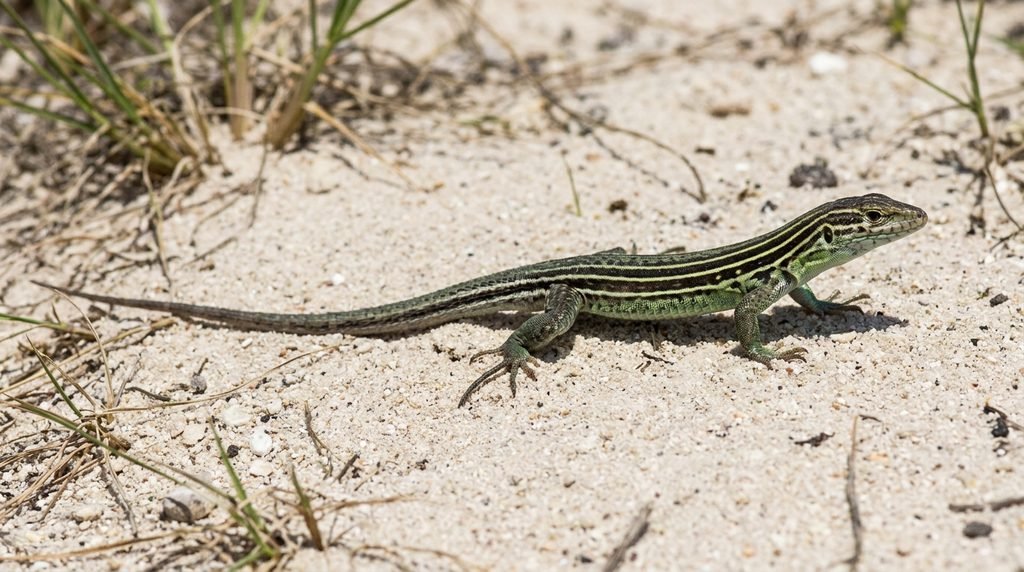
If you notice a small lizard darting across a sandy trail before you can get a good look, it might be a six-lined racerunner. This native Florida species is known for its speed, alert behavior, and distinctive striped appearance.
Appearance and behavior
As its name suggests, the six-lined racerunner usually has six pale stripes running lengthwise along its dark body. Its long tail and streamlined shape help it move quickly across open ground. Adult males may develop a bluish color on parts of the body, particularly during the breeding season.
Unlike anoles that frequently climb vegetation, racerunners are primarily active on the ground. They rely on quick movement to escape danger and may disappear into low vegetation or a small refuge when threatened.
Habitat and diet
Six-lined racerunners favor sunny, open environments such as sandy areas, scrub, dry pine flatwoods, and coastal dunes. They actively search for insects, spiders, and other small invertebrates.
Their preference for warm, exposed ground means they are often easiest to observe during suitable daylight conditions. They are a useful example of how Florida’s lizards have adapted to habitats beyond gardens and trees.
4. Southeastern Five-Lined Skink (Plestiodon inexpectatus)
The southeastern five-lined skink is a native lizard that often goes unnoticed because it spends much of its time near cover. It may be found under logs, loose bark, leaf litter, boards, or other objects that provide protection from predators and extreme temperatures.
What does it look like?
This skink has a smooth, shiny body and five pale stripes running along its back and sides. Young individuals often have a striking blue tail, while adult coloration can become less vivid with age. Its smooth scales give it a different appearance from the rougher-looking racerunners and some anoles.
Skinks can move rapidly when disturbed. A threatened skink may also shed part of its tail, distracting a predator while the lizard escapes. The tail can regrow, although the replacement may not look exactly like the original.
Habitat and food
Southeastern five-lined skinks live in wooded areas, forest edges, and other habitats with plenty of hiding places. They feed mainly on insects and other small invertebrates.
Keeping natural leaf litter and fallen wood in suitable areas can provide useful shelter for these and other small reptiles. However, never lift heavy objects without care when looking for wildlife.
5. Little Brown Skink (Scincella lateralis)
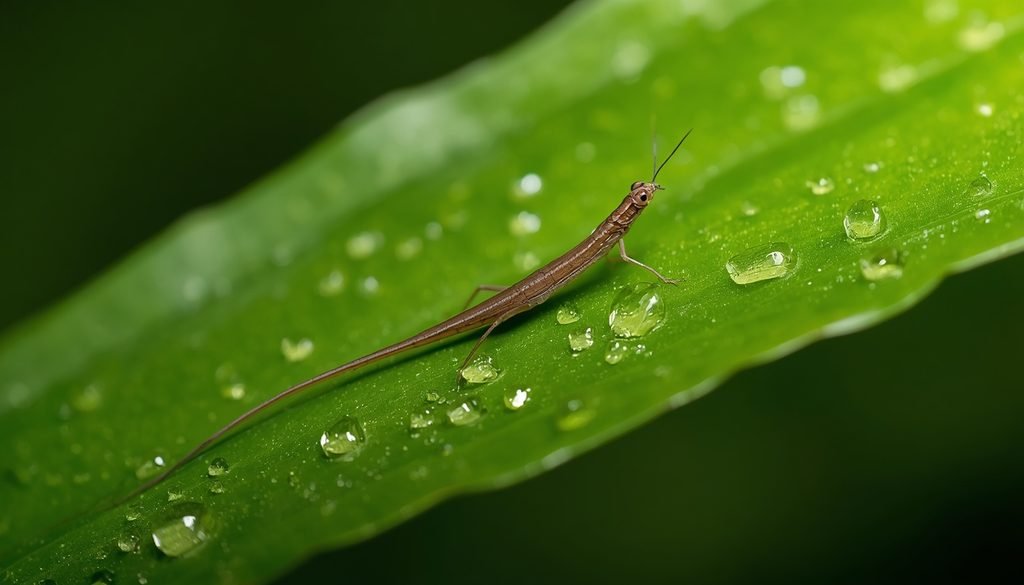
The little brown skink is a tiny native lizard that is easy to overlook. Its small size and brown coloration help it blend into the forest floor, where it moves among damp leaves, soil, and decaying vegetation.
Identification
This skink has a slender body, short legs, smooth scales, and a brown back with darker stripes along the sides. It is much smaller than Florida’s large introduced lizards and generally remains close to ground-level cover.
Because it can move quickly through narrow spaces, it may vanish beneath leaf litter almost as soon as it is noticed. Its secretive habits make it less visible than anoles that perch on walls and branches.
Habitat and diet
Little brown skinks occur in forests, wooded yards, and other areas with suitable ground cover. They eat tiny invertebrates, including small insects and other arthropods.
By feeding on small invertebrates, they contribute to food-web relationships in soil and leaf-litter communities. They are also prey for larger animals, including snakes and birds.
6. Florida Scrub Lizard (Sceloporus woodi)
The Florida scrub lizard is a native species closely associated with Florida’s sandy scrub habitats. These habitats can look dry and sparse, with sandy soil, scattered shrubs, and open patches of sunlight. Although the landscape may appear harsh, it supports wildlife specially adapted to these conditions.
Appearance and distinguishing traits
Florida scrub lizards have a brown or gray-brown body with darker markings that help them blend into sand and vegetation. They have rougher-looking scales than the smooth-bodied skinks. Males may show blue coloring on the belly and sides, while females generally have more subdued coloration.
This species is adapted to life in open, sunlit areas. Like other lizards, it uses external warmth to regulate body temperature and may move between sunny patches and shaded refuges throughout the day.
Habitat and conservation
Florida scrub lizards are associated with scrub ecosystems, especially areas with open sand and scattered low plants. Habitat loss and changes to the natural structure of scrub can reduce suitable living space for wildlife that depends on these specialized environments.
Protecting remaining scrub habitat helps conserve not only this lizard but also the many plants and animals that rely on Florida’s distinctive sandy landscapes.
7. Green Iguana (Iguana iguana)
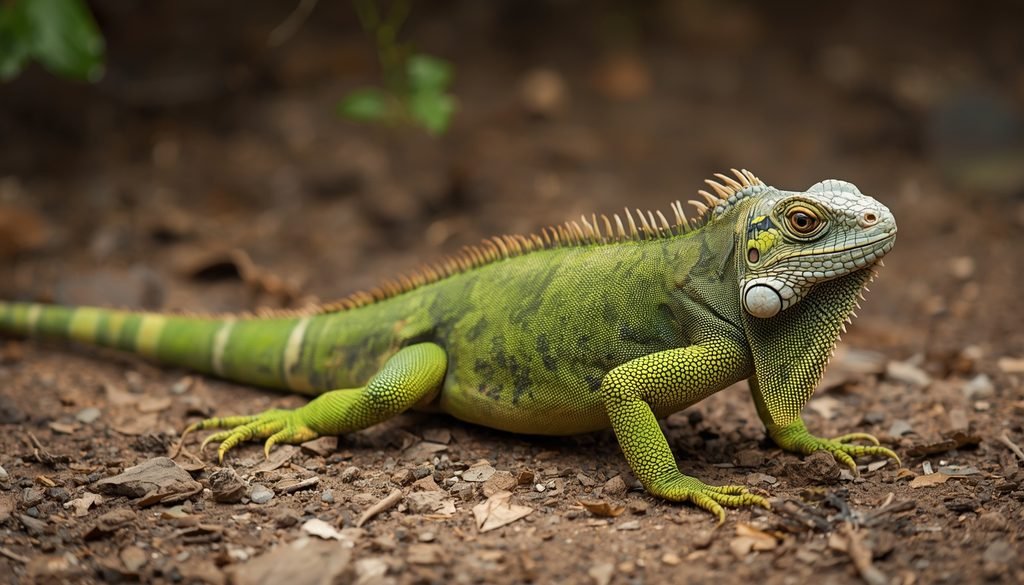
The green iguana is one of Florida’s most recognizable large lizards. Native to parts of Central and South America and the Caribbean, it became established in Florida after being introduced through human activity. It is especially noticeable in parts of South Florida, where warm conditions and abundant vegetation support populations.
Size and appearance
Green iguanas have long tails, strong limbs, a row of spines along the back, and a prominent flap of skin beneath the throat. Young animals are often brighter green, while adults may become darker or develop gray, brown, or orange tones.
Despite their name, they are not always vivid green. Their large size and spiny profile help distinguish them from Florida’s smaller native lizards.
Diet and environmental impact
Green iguanas eat mainly plant material, including leaves, flowers, and fruit. They may feed on ornamental plants, dig burrows near canals or seawalls, and damage landscaping. Their burrowing can also contribute to erosion or affect structures near the water.
Green iguanas are nonnative, and their effects vary by location. If you see one, observe it from a safe distance rather than attempting to catch or handle it.
8. Brown Basilisk (Basiliscus vittatus)
The brown basilisk is an introduced lizard known for its tall crest, long toes, and preference for areas near water. It originated in parts of Central America and has established populations in Florida, particularly in warm southern areas.
Appearance and remarkable movement
Brown basilisks are generally brown or olive-colored, with darker markings and a crest along the head and back. Their long toes help them move across muddy banks and vegetation near streams and canals.
Basilisks are famous for their ability to run across the surface of water for short distances when escaping danger. This behavior depends on speed and rapid foot movements; it does not mean they can remain on the water indefinitely.
Habitat and feeding habits
These lizards often live near canals, ponds, drainage channels, and other waterways with vegetation and basking spots. They eat insects and other small animals, and may also consume some plant material.
As an introduced species, the brown basilisk is part of Florida’s changing reptile community. Its presence is a reminder that waterways and landscaped urban areas can provide suitable habitat for nonnative wildlife.
9. Peter’s Rock Agama (Agama picticauda)
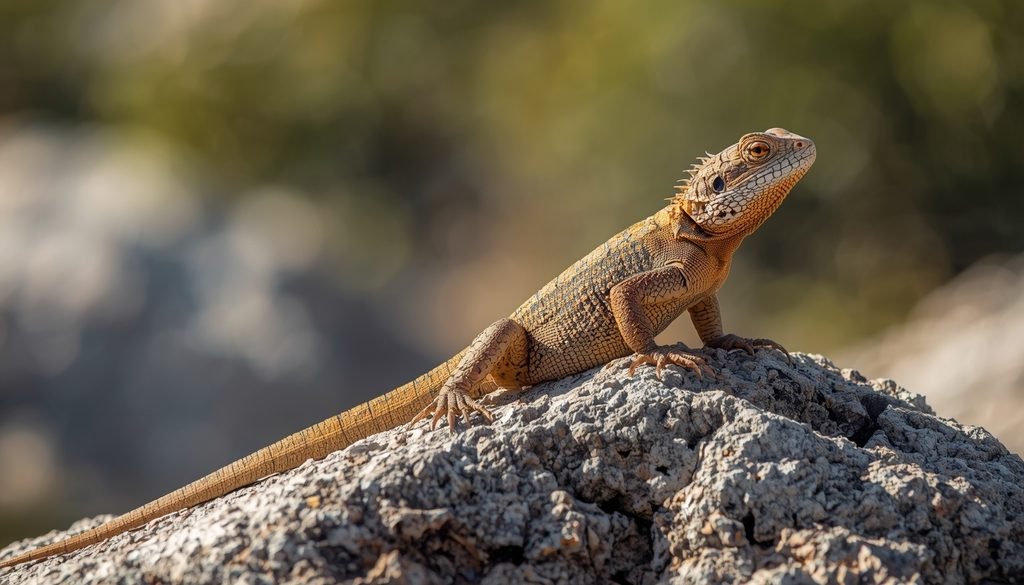
Peter’s rock agama is a nonnative lizard that has become established in parts of Florida. Native to Africa, it has been introduced beyond its original range through the exotic pet trade. In Florida, it is often associated with developed areas where walls, rocks, pavement, and open sunny spaces offer good basking locations.
Color and identification
Adult males can display vivid colors, including a contrasting head and body, especially during breeding or territorial activity. Females and younger individuals are generally less brightly colored, often showing brownish or muted tones.
These differences can make males easy to notice on a sunny wall or roadside surface. Their sturdy bodies and alert posture distinguish them from the smaller, more delicate anoles common around gardens.
Habitat and diet
Peter’s rock agamas use warm, open sites with places to bask and hide. They feed on insects and other small food items. Like many opportunistic lizards, their diet can vary with what is available.
Because this species is nonnative, sightings can be useful for understanding its distribution. Avoid transporting or releasing exotic reptiles, as moving animals can introduce them into new areas.
10. Cuban Knight Anole (Anolis equestris)
The Cuban knight anole is a large anole native to Cuba that has established populations in parts of Florida. It is much bigger and more robust than the green and brown anoles commonly seen in yards, and it is usually associated with trees and vegetation.
Appearance and behavior
Cuban knight anoles are typically green, with a large head, strong limbs, and a pale stripe or marking near the shoulder area. Their coloration can darken under certain conditions. Their size and powerful jaws make them noticeably different from Florida’s smaller anole species.
They often perch on tree trunks and branches, where they can watch for prey and bask in the warmth. If disturbed, they may retreat quickly into dense vegetation or higher parts of a tree.
Diet and ecological concerns
Cuban knight anoles eat insects and other invertebrates, but larger individuals can also consume small vertebrates, including smaller lizards. This broad diet may put them in competition with native wildlife and can make them predators of other small animals.
They are nonnative, and their ecological effects depend on the location and local conditions. Their presence is one reason it is useful to learn how to distinguish introduced lizards from Florida’s native species.
How to Identify Lizards of Florida
Identifying a Florida lizard is easier when you look at several features rather than relying on color alone. Some species change shades, and young lizards can look different from adults.
- Check the body shape: Anoles are generally slender, skinks have smooth shiny scales, and iguanas are much larger with prominent spines.
- Look for stripes: Six-lined racerunners and five-lined skinks have noticeable lengthwise stripes.
- Notice the habitat: A lizard on a tree or fence may be an anole, while one racing across sandy ground may be a racerunner.
- Estimate the size: A large, heavy-bodied lizard may be an iguana, knight anole, or another introduced species.
- Observe from a distance: Photos taken without disturbing the animal can help with identification.
These clues are useful, but exact identification may require a clear photograph and information about the location.
Are Lizards in Florida Dangerous?
Most small lizards commonly seen around Florida homes avoid people and pose little risk when left alone. They may bite if grabbed or cornered, so it is best not to handle unfamiliar reptiles. Larger lizards can scratch or bite if threatened, and their size can make handling particularly risky.
Do not assume every lizard is native or harmless to local wildlife. Some introduced species can affect native animals, vegetation, or infrastructure. If you encounter a large unfamiliar lizard, keep children and pets at a safe distance and consult local wildlife guidance rather than trying to capture it.
Never release a pet lizard into the wild. Releasing nonnative reptiles can contribute to the spread of established populations and create additional ecological problems.
Read More: Animals That Live in Grassland
Frequently Asked Questions
What is the most common lizard in Florida?
Brown anoles are among the most commonly encountered lizards in many parts of Florida, particularly in developed areas. Native green anoles are also familiar, but the two species differ in appearance and origin.
Are green anoles native to Florida?
Yes. The green anole (Anolis carolinensis) is native to Florida. It can change between green and brownish shades, climbs well, and feeds mainly on insects and other small invertebrates.
Why are there so many lizards in Florida?
Florida’s warm climate, varied habitats, abundant insects, and extensive residential landscaping support many lizard species. Human transport and the exotic pet trade have also introduced species that are not native to the state.
What is the difference between native and invasive lizards?
A native lizard occurs naturally in Florida without being introduced by people. A nonnative lizard comes from somewhere else. A nonnative species is considered invasive when it causes harm to native wildlife, habitats, the economy, or people; not every introduced species has the same level of impact.
Should I remove a lizard from my yard?
Small lizards are usually best left alone because they are part of the local ecosystem and often eat insects. If you believe a large lizard is a nonnative species of concern, consult current Florida wildlife guidance before taking action.
Conclusion
The lizards of Florida range from tiny, leaf-litter-dwelling skinks to large, colorful iguanas and knight anoles. Native species such as the green anole, six-lined racerunner, little brown skink, and Florida scrub lizard illustrate the state’s natural diversity. Introduced species, including the brown anole, green iguana, brown basilisk, Peter’s rock agama, and Cuban knight anole, show how human activity has changed Florida’s reptile community.
Learning their appearance, diet, habitat, and behavior makes wildlife watching more rewarding and helps people recognize when a species may need attention. The best approach is to observe lizards without disturbing them, protect natural habitats, and never release exotic pets into the wild.

One thought on “Lizards of Florida: 10 Fascinating Species You Should Know”