
Introduction
Nature is full of animals that survive by doing more than simply running fast or using physical strength. Some hide in plain sight, others create clever ways to capture food, and a few can solve problems that appear surprisingly complex. These behaviors make certain species fascinating examples of cunning animals.
Animal cunning can take many forms. A predator might wait patiently for the perfect moment to attack, while a smaller creature may imitate something dangerous to avoid becoming a meal. Intelligent animals can also learn from experience, remember useful information, and change their behavior when a familiar strategy stops working.
However, not every clever-looking action is deliberate deception. Camouflage, mimicry, and defensive behaviors have evolved over generations because they can improve an animal’s chances of survival. Other behaviors, such as flexible problem-solving and social strategies, provide evidence of learning and behavioral adaptability.
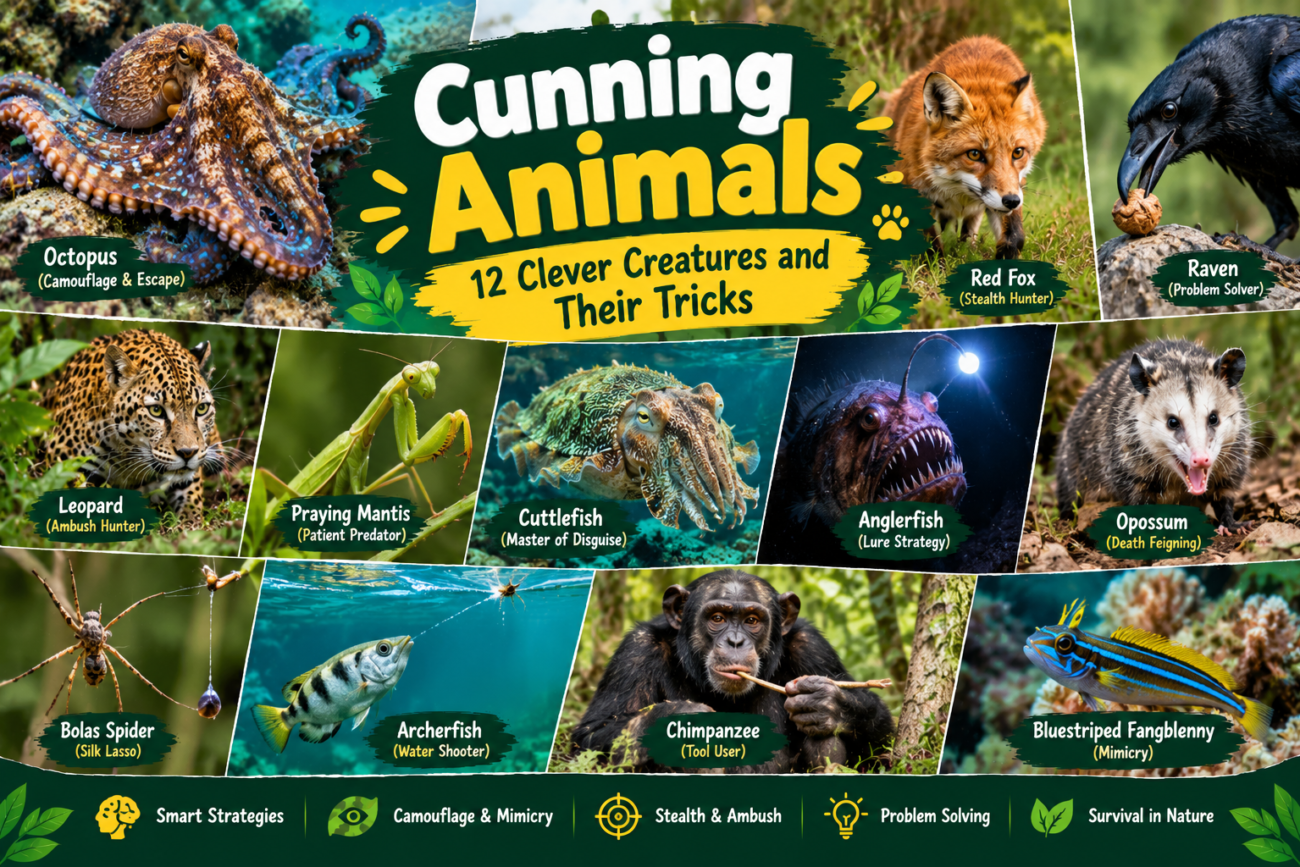
In this guide, we explore 12 cunning animals and explain how their unusual abilities help them hunt, escape predators, obtain food, or compete with other animals. From shape-shifting octopuses to problem-solving ravens, each species reveals a different side of survival in the natural world.
Quick Answer: What Are the Most Cunning Animals?
Some of the most fascinating cunning animals include the octopus, cuttlefish, red fox, raven, leopard, praying mantis, anglerfish, opossum, bolas spider, archerfish, chimpanzee, and bluestriped fangblenny. These animals use different strategies to survive, including camouflage, ambush hunting, mimicry, problem-solving, defensive displays, and social behavior. Octopuses can manipulate objects and escape confined spaces, ravens solve complex food-related problems, and leopards use stealth to approach prey. Their abilities demonstrate that animal cunning is not one single trait but a combination of specialized adaptations, learning, and behavior.
1. Octopus: The Clever Escape Artist
Scientific name: Octopoda
Class: Cephalopoda
Diet: Crabs, shrimp, mollusks, and other marine animals
Habitat: Oceans worldwide, from coastal reefs to deeper waters
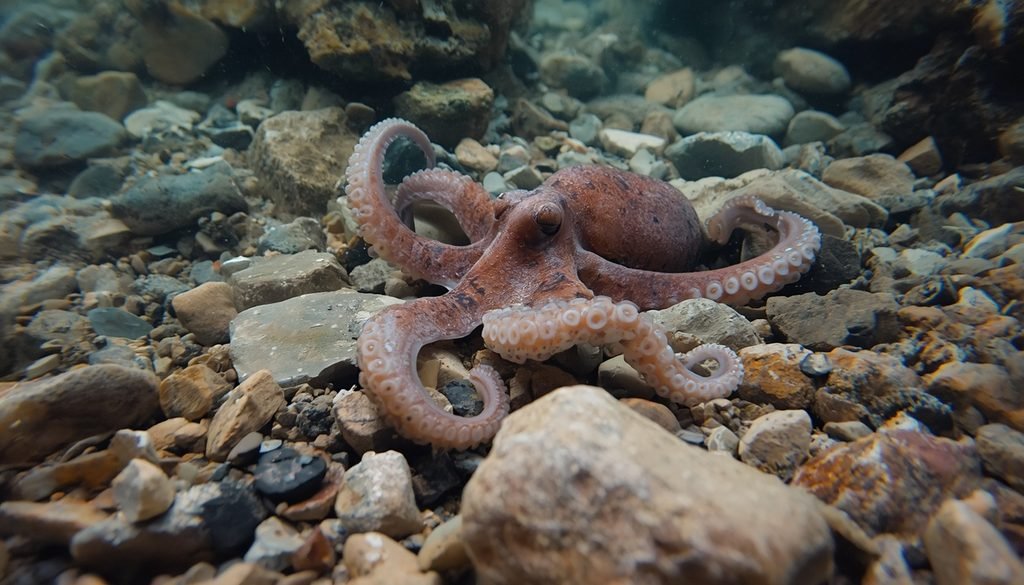
Octopuses are famous for their flexibility, camouflage, and impressive problem-solving abilities. Their soft bodies allow them to squeeze through surprisingly narrow openings, provided the opening is large enough for their hard beak. This makes them particularly effective at escaping spaces that would trap many other animals.
An octopus can also change its color and skin texture to blend into rocks, sand, and coral. Specialized skin cells help it produce rapid visual changes, making it harder for predators to recognize its outline. Depending on the species and situation, camouflage can help an octopus hide from danger or approach prey.
Some octopuses manipulate objects, open containers, and explore unfamiliar surroundings. Such behaviors suggest flexible learning rather than reliance on one fixed response. When an escape route becomes blocked, an octopus may investigate alternative options.
Its reputation as a cunning animal comes from the combination of a highly adaptable body and a nervous system capable of sophisticated behavior. However, not every octopus displays the same abilities; intelligence and behavior differ among species.
2. Cuttlefish: Masters of Disguise
Scientific name: Sepiida
Class: Cephalopoda
Diet: Crustaceans, fish, and other small marine animals
Habitat: Coastal marine environments around the world
Cuttlefish are close relatives of octopuses and squid, but they have their own remarkable approach to survival. Their skin contains specialized structures that allow them to change color and create patterns rapidly. Some species can also alter the apparent texture of their skin, helping them resemble parts of the seafloor.
This camouflage has several uses. A cuttlefish may blend into its surroundings to avoid predators, or it may remain difficult to detect while approaching prey. Its ability to change appearance gives it an advantage in habitats where a visible outline can attract unwanted attention.
Certain cuttlefish also use visual displays during courtship and competition. In some species, males can display different patterns toward different viewers, including a courtship display on one side and a more subdued appearance on the other. Such behavior shows how visual signals can serve several purposes.
Cuttlefish are not simply changing colors randomly. Their displays respond to environmental and social information. This combination of camouflage, communication, and flexible behavior makes them some of the ocean’s most fascinating survival specialists.
3. Red Fox: The Opportunistic Problem-Solver
Scientific name: Vulpes vulpes
Class: Mammalia
Diet: Small mammals, birds, insects, fruits, and other available food
Habitat: Forests, grasslands, mountains, farmland, and urban areas
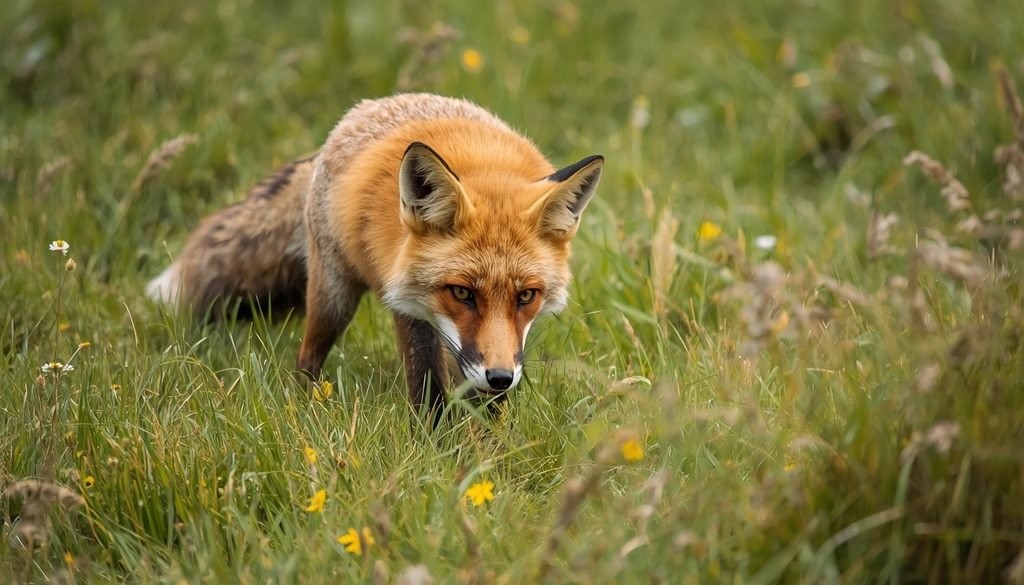
The red fox has a long-standing reputation for cleverness, and its adaptable lifestyle helps explain why. Rather than depending on a single food source, this mammal can change its diet according to the season and what is available nearby.
When hunting small mammals, a fox may pause, listen for movement beneath grass or snow, and then leap toward the suspected location of its prey. It can also use vegetation, terrain, and darkness to approach without being noticed.
Foxes are opportunistic feeders. If hunting becomes difficult, they may search for insects, fruit, carrion, or discarded food. In towns and cities, some learn to take advantage of predictable human activity while avoiding busy places or times.
This flexibility is an important part of their success. The fox does not need to overpower every opponent or catch every target through speed. By using different feeding strategies and responding to local conditions, it can make the most of changing opportunities.
Although stories often portray foxes as master tricksters, their real abilities are best understood through their adaptability, learning, and effective use of their environment.
4. Raven: A Remarkable Bird With a Strategic Mind
Scientific name: Corvus corax
Class: Aves
Diet: Carrion, insects, eggs, small animals, and plant material
Habitat: Mountains, forests, coastal regions, open landscapes, and some urban areas
Ravens are among the most intelligent birds studied by scientists. They investigate unfamiliar objects, learn from experience, remember food locations, and solve problems when trying to obtain a meal.
A raven may hide food for later use, especially when it has more than it can eat immediately. Because other ravens can steal stored food, the bird’s behavior may change depending on whether competitors are nearby. Some food-caching behavior suggests that ravens respond to the risk of theft, although the exact cognitive abilities involved depend on the situation.
Ravens also take advantage of opportunities created by other animals. They may feed on carcasses left by large predators or investigate places where food is likely to appear. Their curiosity and ability to learn help them survive in different environments.
Their intelligence does not mean that every raven action is carefully planned. Some behaviors are learned through experience, while others reflect instinct or immediate responses. Still, their flexible problem-solving and memory make ravens outstanding examples of clever animal behavior.
5. Leopard: The Stealthy Ambush Hunter
Scientific name: Panthera pardus
Class: Mammalia
Diet: Deer, antelope, monkeys, rodents, and other available prey
Habitat: African and Asian forests, grasslands, scrublands, and mountainous regions
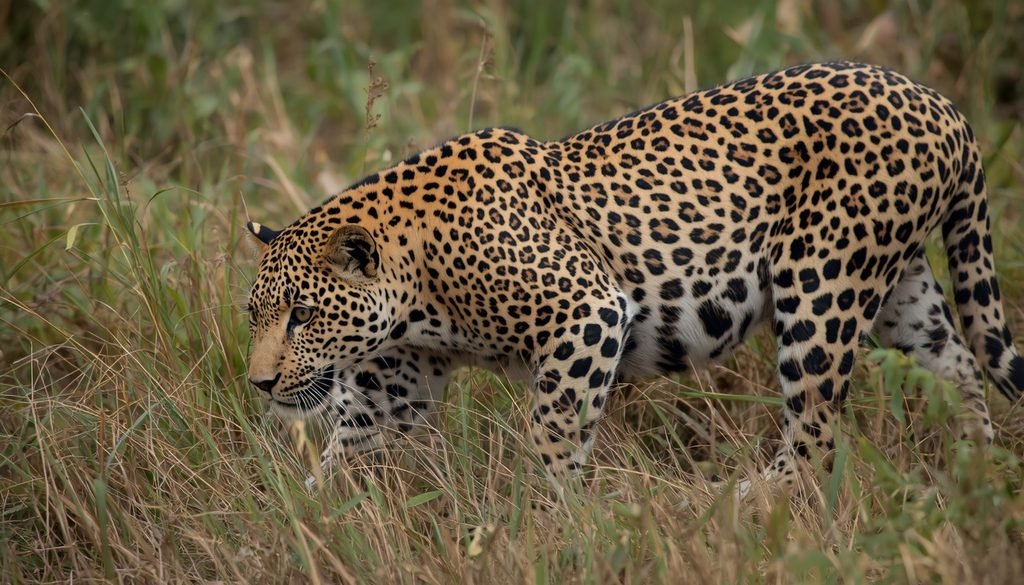
Leopards are powerful predators, but their success depends heavily on stealth. Instead of pursuing every animal across long distances, they often use vegetation, shadows, rocks, and uneven terrain to approach prey without being detected.
Their spotted coats help break up the outline of their bodies in dappled light. When a leopard remains still among branches or dense vegetation, its markings can make it surprisingly difficult to distinguish from the background.
A leopard generally tries to get close before launching a short, powerful attack. This approach reduces the distance it must cover and can conserve energy compared with a prolonged chase. Leopards may also drag prey into trees, where doing so helps protect a meal from some competing scavengers and predators.
Their hunting success relies on a combination of camouflage, patience, strength, and careful positioning. Although leopards are not necessarily devising elaborate plots, their ability to use the landscape effectively makes them classic examples of cunning predators.
6. Praying Mantis: The Patient Predator
Scientific name: Mantodea
Class: Insecta
Diet: Insects and other small animals; larger species may capture small vertebrates
Habitat: Gardens, forests, grasslands, shrubs, and tropical vegetation
A praying mantis uses a very different strategy from a fast-chasing predator. Rather than spending energy pursuing every possible meal, it often waits for prey to come within striking distance.
Its elongated body and green, brown, or patterned coloration may help it blend into leaves, stems, and other vegetation. Some species resemble flowers, twigs, or dried plant material, making them less conspicuous to both prey and predators.
When an insect approaches, the mantis can extend its spiny front legs with remarkable speed and grip the prey. This ambush method works because the insect stays relatively still until the right moment.
Not all mantises use identical camouflage, and their hunting success depends on species and surroundings. Nevertheless, their combination of concealment, patience, and rapid movement makes them highly effective small predators.
The mantis illustrates an important lesson about cunning in nature: sometimes survival depends not on being the fastest animal, but on choosing the right place and waiting for the right opportunity.
7. Anglerfish: A Predator With a Built-In Lure
Scientific name: Lophiiformes
Class: Actinopterygii
Diet: Fish and other animals that can be captured
Habitat: Marine environments, including deep-sea habitats for many species
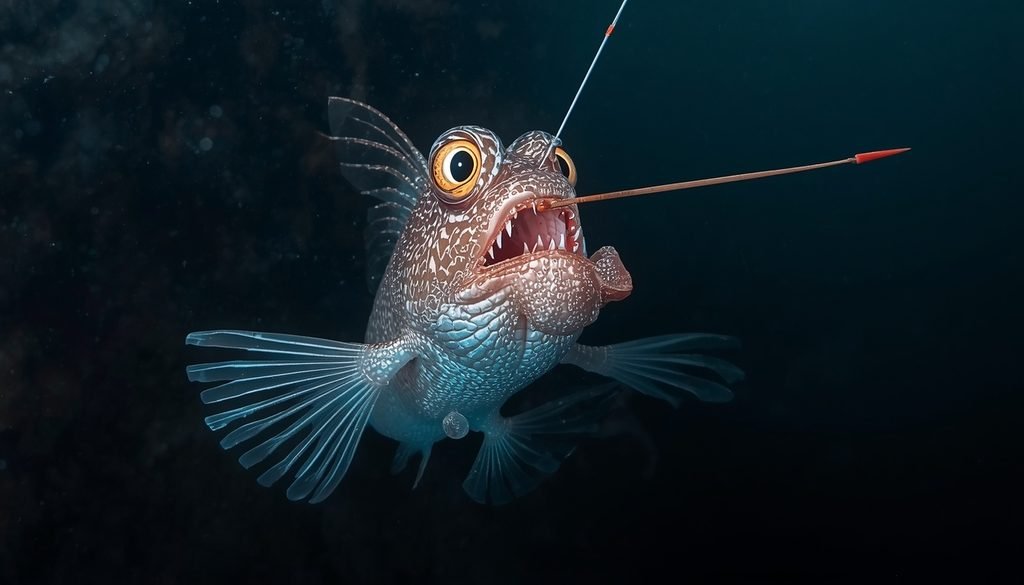
Some anglerfish have a specialized structure extending from the head that acts as a lure. In certain deep-sea species, this structure carries a light-producing organ, while other anglerfish use lures that are not bioluminescent.
In the darkness of the deep ocean, light can attract the attention of nearby animals. A curious fish approaching a lure may move close enough for the anglerfish to seize it. This strategy can be more efficient than searching widely for prey in an environment where food may be scarce.
Anglerfish also have large mouths and expandable stomachs in many species, allowing them to swallow substantial prey relative to their own size. Their bodies and feeding strategies are adapted to the conditions of their particular marine habitats.
It is important to remember that not every anglerfish lives in the deep sea or uses a glowing lure. The group is diverse, and hunting techniques vary.
Where a lure is used, however, the principle is remarkable: rather than chasing prey, the predator creates a signal that brings potential food within reach.
8. Opossum: Playing Dead to Escape Danger
Scientific name: Didelphis virginiana
Class: Mammalia
Diet: Insects, fruits, small animals, eggs, and carrion
Habitat: Woodlands, wetlands, farmland, and suburban areas in North America
The Virginia opossum is known for a defensive response commonly called “playing dead.” When severely threatened, it may become unresponsive, lie on its side, and appear lifeless. Its mouth may remain open, and it can release unpleasant-smelling secretions that reinforce the impression that it is not a desirable meal.
This response is generally involuntary rather than a carefully planned performance. In other words, the opossum is not necessarily deciding to trick a predator in the way a person might devise a plan. The behavior can occur during intense stress and may reduce the attacker’s interest.
The tactic is most likely to help against predators that lose interest in prey that appears dead or unappealing. It will not work against every threat, and it does not guarantee survival.
Opossums also survive through their flexible diet and ability to use a variety of habitats. Their scavenging helps them consume carrion and other available food.
Their defensive behavior is a useful example of how a strategy that looks like deception to humans can evolve as a response to danger.
9. Bolas Spider: The Silk-Lasso Hunter
Scientific name: Mastophora species
Class: Arachnida
Diet: Primarily moths
Habitat: Vegetation in forests, woodland edges, and other suitable habitats, depending on the species
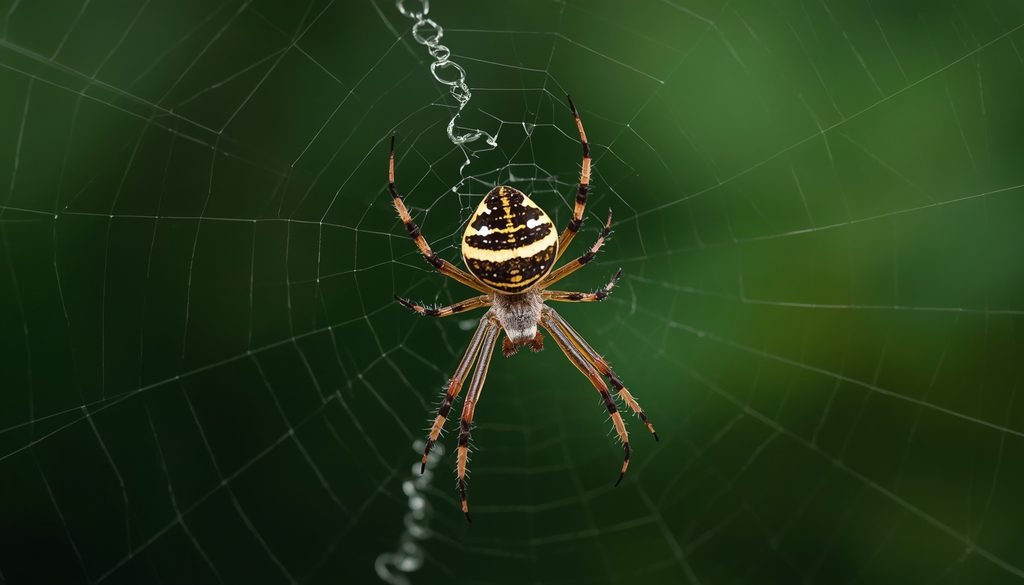
Many spiders capture prey with webs, but bolas spiders use a different method. A female bolas spider produces a short silk line with a sticky droplet at its end. She swings this line toward passing moths, allowing the sticky material to catch the insect.
Some bolas spiders also release chemical signals that imitate sex pheromones produced by female moths of particular species. Male moths attracted by these signals may approach closely enough to be captured.
This strategy combines two useful features: luring prey and using a specialized tool to catch it. Rather than constructing a large web and waiting for an insect to become trapped, the spider can target suitable prey that responds to its chemical signals.
The technique is specialized, and not every spider in the broader spider group hunts this way. Bolas spiders’ success depends on the prey species available and the effectiveness of their lures.
Their unusual hunting method demonstrates that cunning survival strategies do not require a large brain or complex social life. Evolution can produce highly specialized behavior that works remarkably well for a particular ecological niche.
10. Archerfish: The Fish That Shoots Water
Scientific name: Toxotes species
Class: Actinopterygii
Diet: Insects and other small animals, including prey near the water’s surface
Habitat: Brackish and freshwater habitats, including mangroves and estuaries in parts of Asia and Oceania
Archerfish have an unusual way of catching food: they shoot a jet of water at insects and other small prey resting above the surface. If the target loses its grip and falls into the water, the fish can quickly move in to eat it.
Accurate shooting requires the fish to respond to the target’s position and the way light behaves at the water’s surface. An object viewed from underwater may appear displaced because light bends as it passes between water and air. Archerfish can compensate for this visual challenge when aiming at prey.
Some studies also show that archerfish can learn to distinguish visual targets and improve their performance with experience. This makes their feeding behavior particularly interesting to researchers studying animal learning.
The archerfish’s strategy lets it access food that many other fish cannot easily reach. Rather than jumping out of the water or chasing an insect through the air, it uses water itself as a hunting tool.
11. Chimpanzee: Social Intelligence and Tactical Behavior
Scientific name: Pan troglodytes
Class: Mammalia
Diet: Fruit, leaves, seeds, insects, and sometimes meat
Habitat: Tropical forests and woodland habitats in parts of equatorial Africa
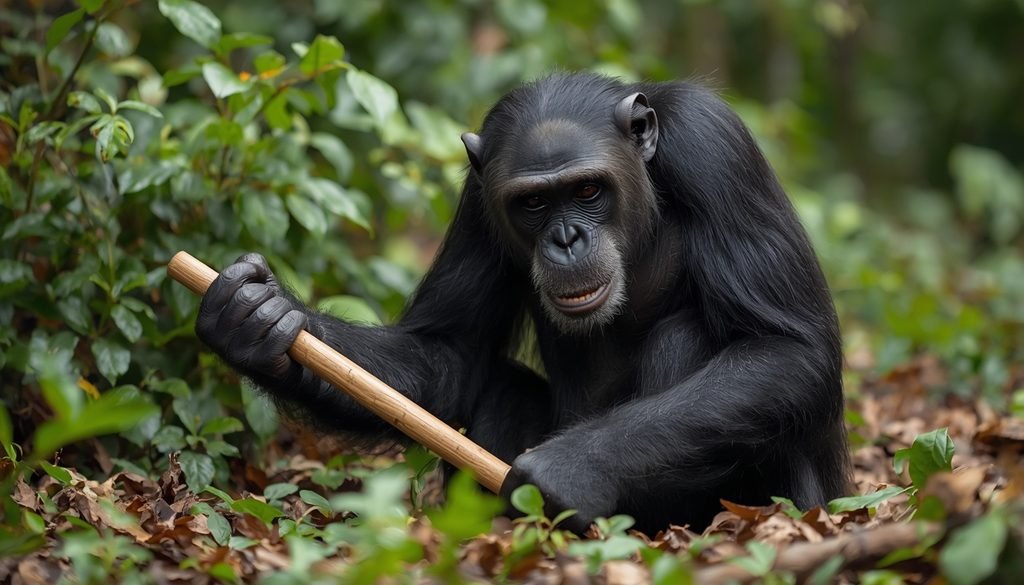
Chimpanzees are highly social primates with complex relationships. They cooperate, compete for resources, form alliances, and learn behaviors from other group members. These social demands make flexibility and awareness of other individuals especially valuable.
Chimpanzees have been observed using tools to obtain food, including sticks for extracting insects and other tools for accessing difficult-to-reach resources. Different communities may develop different tool-use traditions, showing that learning from others can shape behavior.
Research has also documented situations in which chimpanzees conceal their approach to contested food from a competitor. Such observations suggest that they can sometimes adjust their actions based on what another individual can see. Scientists continue to investigate how much these behaviors reflect deliberate perspective-taking versus learned responses to familiar situations.
Their social lives involve more than deception. Cooperation, grooming, communication, and conflict resolution are all important parts of chimpanzee society.
Chimpanzees are considered cunning animals because they combine practical problem-solving with sophisticated social behavior. Their intelligence is best understood through multiple observations rather than by assuming that every action has a hidden plan.
12. Bluestriped Fangblenny: The Reef Fish That Mimics Others
Scientific name: Plagiotremus rhinorhynchos
Class: Actinopterygii
Diet: Small fish and, in some feeding contexts, pieces of skin or tissue
Habitat: Tropical coral reefs in the Indo-Pacific region
The bluestriped fangblenny is a small reef fish that can resemble cleaner wrasses in appearance. Cleaner wrasses normally remove parasites and dead tissue from larger fish, and other reef animals may allow them to approach closely because of this useful relationship.
The fangblenny can exploit that familiarity. By resembling a cleaner fish, it may get close to other fish and take a bite before escaping. This behavior is a form of aggressive mimicry: an animal resembles another organism or uses a familiar signal to gain a feeding opportunity.
The strategy is not risk-free. Potential victims may react aggressively after recognizing the trick, and repeated encounters can make the mimic less successful. The behavior depends on the local reef community and how other fish respond to cleaner-fish signals.
This example shows that mimicry can be used not only to hide from predators but also to approach prey. In the natural world, appearances and signals can influence how animals interact, creating opportunities for both cooperation and exploitation.
What Makes an Animal Cunning?
Cunning is not a formal scientific category, and there is no single test that identifies the world’s most cunning animal. Researchers instead study particular abilities and behaviors.
Camouflage and Mimicry
Some animals reduce the chance of being detected by matching their surroundings. Others resemble a different organism or use a misleading signal. These adaptations can help animals avoid predators or get closer to prey.
Learning and Problem-Solving
Animals such as ravens, octopuses, and chimpanzees can learn from experience and respond flexibly to certain challenges. These abilities differ among species and individuals, but they demonstrate that animal behavior is not always limited to fixed instinctive responses.
Patience and Ambush
Leopards and praying mantises show how waiting, concealment, and precise timing can improve hunting success. Their strategies rely on physical adaptations as well as behavior.
Defensive Deception
Some animals use behaviors that make them appear less attractive or harder to recognize. The opossum’s death-feigning response is one example, although it is generally an involuntary defensive reaction rather than a conscious plan.
Read More: Animals With Small Eyes
Frequently Asked Questions
What is the most cunning animal in the world?
There is no universally accepted winner. Octopuses, ravens, chimpanzees, and other animals demonstrate different forms of problem-solving, learning, camouflage, or social behavior. Which animal seems most cunning depends on the ability being compared.
Which animal is known for being sneaky?
Foxes and leopards are commonly associated with sneaky behavior because they use stealth and careful approaches while hunting. Octopuses are also known for camouflage and their ability to escape confined spaces.
Are cunning animals always intelligent?
No. Some behaviors that appear clever are specialized adaptations that evolved over many generations. Camouflage and mimicry can work without requiring the animal to understand the strategy in a human-like way. Flexible problem-solving, by contrast, can provide evidence of learning or more complex cognition.
Which animal uses deception to catch prey?
Several species use deceptive signals or appearances. Bolas spiders can attract moths with chemical signals, certain anglerfish use lures to draw prey closer, and bluestriped fangblennies can exploit their resemblance to cleaner fish.
Why do animals use cunning survival strategies?
These strategies can help animals obtain food, avoid predators, protect resources, or compete with other individuals. Natural selection can favor behaviors that improve survival and reproduction in a particular environment.
Conclusion
The world’s cunning animals show that survival depends on much more than strength and speed. Octopuses escape through narrow openings, cuttlefish change their appearance, ravens solve food-related problems, and leopards use stealth to approach prey. Other animals rely on specialized lures, mimicry, or defensive responses.
These strategies are not all evidence of human-like planning. Some are inherited adaptations, while others involve learning and flexible responses to changing situations. Understanding the difference makes animal behavior even more interesting.
From the ocean floor to tropical forests and open grasslands, these 12 creatures reveal the many ways animals use their bodies, senses, and behavior to survive. Their remarkable adaptations remind us that nature’s most effective strategies are often subtle, specialized, and surprisingly diverse.
