
Introduction
Hearing is an important sense for many animals, but not every creature needs ears or a conventional auditory system to survive. Some animals do not have specialized structures for hearing, while others depend on different ways of sensing their surroundings. Instead of listening for danger, these creatures may detect touch, vibrations, chemicals, light, water movement, or changes in their environment.
The term animals that are deaf can therefore describe several different biological situations. A creature may lack external ears, have no conventional hearing organs, or simply rely on sensory systems that work differently from those of mammals.
From tiny worms to ocean dwelling jellyfish and fascinating sea sponges, these animals show how diverse sensory perception can be in the animal kingdom. Understanding how they experience the world also reveals how evolution has produced different solutions for finding food, avoiding danger, reproducing, and surviving.
What Animals Are Deaf?
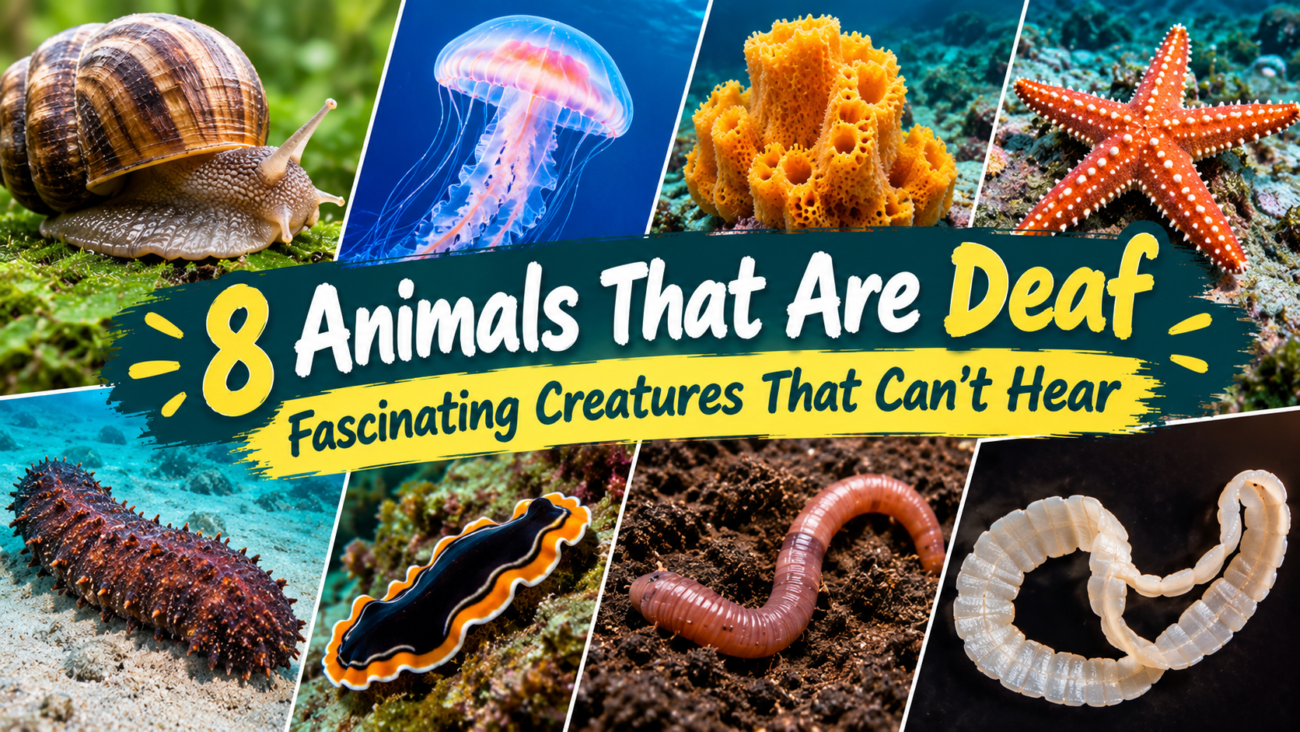
Some animals are considered unable to hear in the conventional sense because they lack specialized auditory organs. Examples include giant African snails, sea sponges, starfish, sea cucumbers, flatworms, earthworms, and tapeworms, while jellyfish lack ears and use other sensory mechanisms instead. These animals rely on touch, chemical signals, light, pressure, or vibrations to interact with their surroundings.
What Does It Mean When an Animal Is Deaf?
When people say an animal is deaf, they may mean that it cannot hear sound through a conventional auditory system. However, deafness is not the same thing as having no visible ears. Many animals have no external ears but still possess internal structures that allow them to detect sound.
Some of the animals in this list have no specialized hearing organs at all. Others can detect mechanical changes, vibrations, pressure, or water movement without processing sound in the same way that mammals do. This distinction is important because an animal can respond to a vibration without actually “hearing” it.
In simple terms, animals that lack conventional hearing often compensate with other sensory abilities. Their bodies may be especially sensitive to touch, chemicals, light, movement, or changes in their environment.
Quick List: 8 Animals That Are Deaf
| Animal | Scientific Name/Group | Hearing Status | Main Sensory System |
| Giant African Snail | Achatina fulica | No conventional hearing | Smell, sight, touch |
| Jellyfish | Scyphozoa | No conventional ears | Light, touch, mechanical cues |
| Sea Sponge | Porifera | No auditory system | Cellular and water flow responses |
| Starfish | Asteroidea | No conventional hearing | Touch, light, chemicals |
| Sea Cucumber | Holothuroidea | No conventional hearing | Touch and chemical cues |
| Flatworm | Platyhelminthes | No conventional hearing | Light, chemicals, mechanical cues |
| Earthworm | Lumbricidae | No ears or conventional hearing | Touch, vibration, chemicals |
| Tapeworm | Cestoda | No conventional hearing | Chemical and physical cues |
1. Giant African Snail
Scientific name: Achatina fulica
Class: Gastropoda
Diet: Plants, fruits, vegetables, and organic matter
Habitat: Tropical and subtropical environments

The giant African snail is one of the clearest examples of an animal that does not have hearing as a conventional sense. It has no ears and does not depend on sound to understand its environment. Instead, this large land snail uses other sensory abilities to find food, avoid danger, and interact with its surroundings.
Its tentacles are particularly important. The longer upper tentacles contain eyes, while other sensory structures help the snail respond to its environment. Chemical cues and smell are useful when locating food and other snails.
Rather than listening for predators, the giant African snail responds to physical contact and environmental changes. Its slow lifestyle also means that hearing is not essential to its survival.
Interesting fact: Despite its simple appearance, the giant African snail has a surprisingly effective collection of sensory systems.
2. Jellyfish
Scientific group: Scyphozoa
Diet: Small fish, plankton, larvae, and other marine organisms
Habitat: Oceans and coastal waters
Jellyfish do not have ears or a brain like vertebrates, so they do not hear sound in the conventional mammalian sense. Their simple bodies are adapted to life in the water, where detecting light, touch, movement, and other physical changes is more useful than having complex ears.
Jellyfish possess specialized sensory structures that help them respond to their surroundings. Some can detect changes in light, while other structures help with balance and orientation. Their bodies can also respond to mechanical stimulation and water movement.
This means it is more accurate to say that jellyfish lack conventional hearing rather than claiming they are completely insensitive to every sound or vibration. Their sensory systems are simply very different from those of animals with ears.
Interesting fact: A jellyfish can survive without a centralized brain because its simple nervous system is enough for many basic responses.
3. Sea Sponge
Scientific group: Porifera
Diet: Microscopic organisms and organic particles filtered from water
Habitat: Mostly marine environments
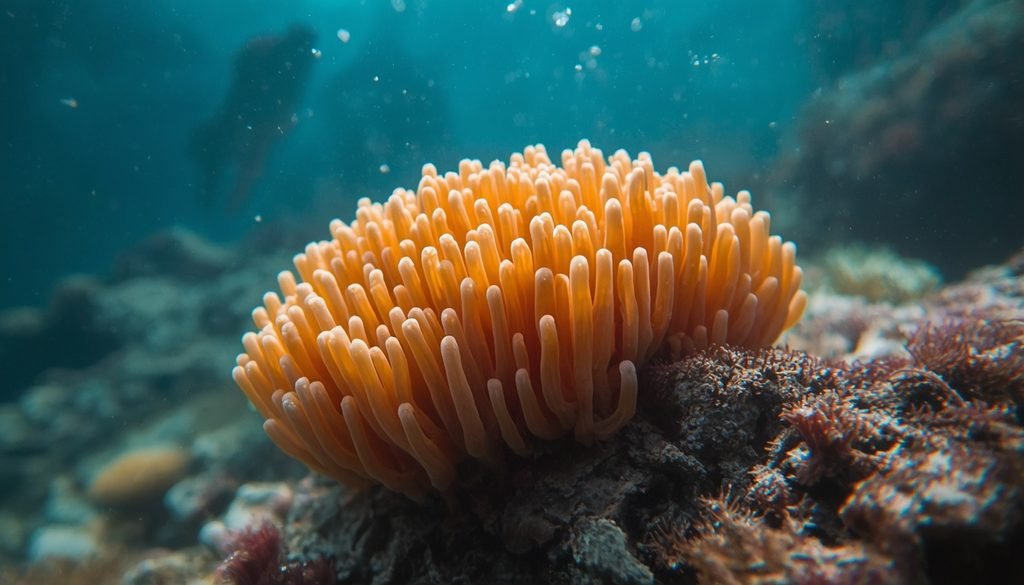
Sea sponges may look like plants, but they are actually animals. They have no conventional ears and no nervous system like that found in most familiar animals. Because of this, a sea sponge cannot hear sounds in the normal sense.
Sponges are filter feeders. Water constantly moves through openings in their bodies, carrying oxygen and microscopic food particles. Their cells can respond to changes in water flow and other environmental conditions.
This makes the sponge a remarkable example of how an animal can function without a brain, ears, or a conventional nervous system. Instead of hearing a threat, its cells respond directly to changes in the surrounding environment.
Interesting fact: Sponges are among the simplest animals, yet research has revealed surprisingly sophisticated cellular communication systems.
4. Starfish (Sea Star)
Scientific group: Asteroidea
Diet: Mollusks, small animals, algae, and organic material
Habitat: Marine environments
Starfish, also called sea stars, do not have ears or a conventional auditory system. Instead, they depend on several other sensory abilities to navigate their underwater habitats.
Their tube feet are important for movement and sensing physical contact. Starfish can also respond to chemical signals in the water, helping them detect potential food sources. Many species have eyespots near the ends of their arms that detect light and help with orientation.
Although a starfish does not have a centralized brain, it has a nervous system that coordinates movement and sensory information. Its ability to sense touch, light, chemicals, and environmental conditions allows it to survive without conventional hearing.
Interesting fact: Some starfish have simple eyes at the tips of their arms.
5. Sea Cucumber
Scientific class: Holothuroidea
Diet: Organic particles, algae, and material from the seafloor
Habitat: Ocean floors
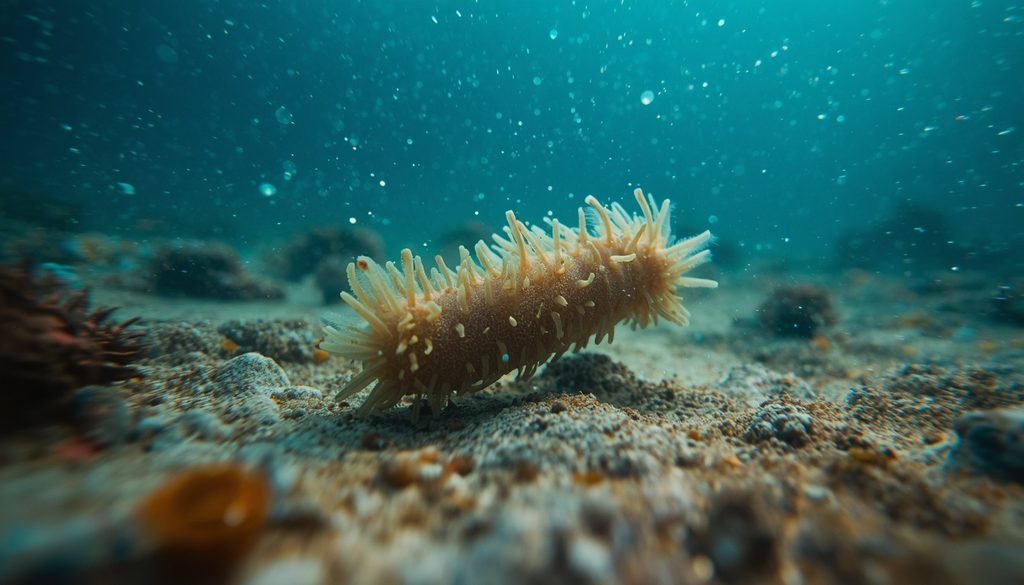
Sea cucumbers are soft bodied marine animals that spend much of their lives moving slowly across the ocean floor. They do not have conventional ears or a specialized hearing system.
Instead, these animals depend on physical and chemical information from their surroundings. Their body structures can detect contact and changes around them, while chemical cues help them interact with their environment.
Their feeding strategy also makes hearing unnecessary. Sea cucumbers often collect organic material from sediments using specialized tentacles around the mouth. Their survival depends more on sensing food, water conditions, physical contact, and potential threats than listening for sounds.
Interesting fact: Some sea cucumbers can use unusual defensive behaviors when threatened, depending on the species.
6. Flatworm
Scientific group: Platyhelminthes
Diet: Varies by species
Habitat: Freshwater, marine habitats, moist environments, and hosts
Flatworms are a diverse group of animals with simple, flattened bodies. They do not have conventional ears or a mammal like auditory system. Instead, many flatworms depend on sensory structures that detect light, chemicals, touch, and mechanical changes.
Free living flatworms may use eyespots to detect changes in light and help them move toward or away from particular environments. Chemical sensing can also help them locate food or recognize conditions around them.
Parasitic flatworms have additional adaptations for living inside hosts. Their sensory systems are suited to the environments they occupy rather than to detecting airborne sounds.
Interesting fact: Some flatworms have surprisingly complex behaviors despite their small and simple bodies.
7. Earthworm
Scientific family: Lumbricidae
Diet: Decaying organic material and soil organisms
Habitat: Moist soil
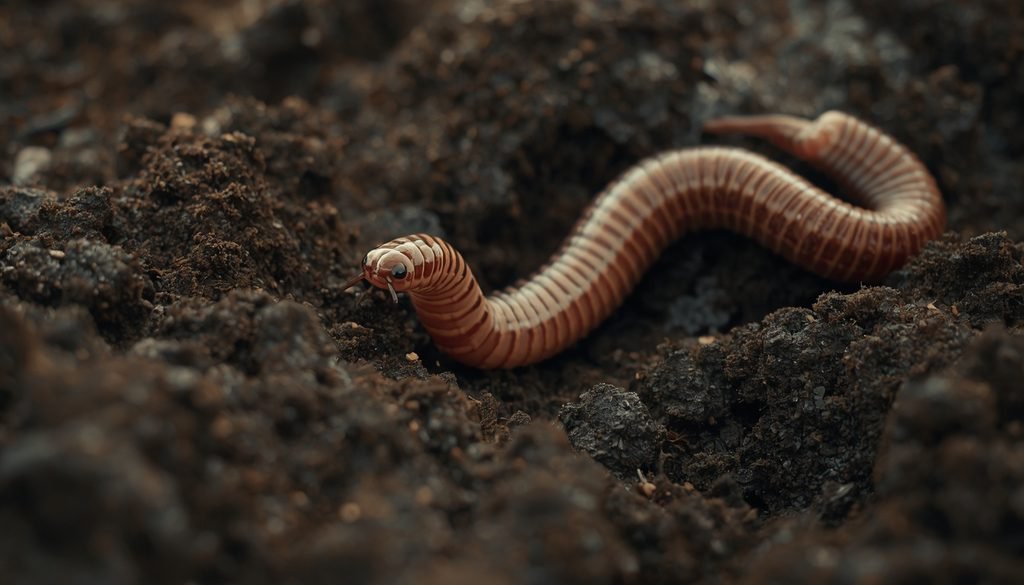
Earthworms have no ears and do not possess a conventional auditory system. However, this does not mean they are completely insensitive to movement. Earthworms are highly responsive to touch, pressure, moisture, chemicals, and vibrations traveling through the soil.
When the ground around them is disturbed, an earthworm may react quickly. This can happen because mechanical vibrations and physical changes stimulate sensory cells in its body. Such responses can help the worm avoid danger even without hearing a predator’s footsteps as humans would.
Earthworms are therefore a good example of why detecting vibrations is not necessarily the same as hearing sound. Their survival depends on sensing the soil directly around them.
Interesting fact: Earthworms breathe through their moist skin rather than lungs.
8. Tapeworm
Scientific class: Cestoda
Diet: Nutrients absorbed from the host
Habitat: Inside animal digestive systems
Tapeworms are parasitic flatworms that spend their adult lives inside the bodies of hosts. They have long, flattened bodies and specialized structures for attaching to their hosts and absorbing nutrients.
Tapeworms do not have ears or a conventional auditory system. Living inside a host creates a very different environment from the outside world, so detecting airborne sound would provide little survival benefit.
Instead, tapeworms respond to chemical and physical conditions within their environment. Their sensory structures help them interact with the host and maintain their position within the digestive tract.
Interesting fact: Tapeworms have no digestive tract of their own and absorb nutrients through their body surface.
How Do Deaf Animals Sense Their Environment?
Animals that lack conventional hearing use other sensory systems to understand what is happening around them. Touch is especially important for animals such as earthworms and starfish because physical contact can reveal obstacles, predators, food, or changes in the environment.
Chemical sensing is another major strategy. Chemicals in water, soil, or a host’s body can provide information about food, mates, predators, or suitable habitats.
Some animals also detect light and changes in brightness. Starfish, for example, have eyespots that help them respond to light. Aquatic organisms may also respond to pressure and water movement.
Vibrations and mechanical signals can provide another form of environmental information. An earthworm may respond to movement in the soil without possessing an auditory system.
These adaptations show that hearing is only one possible way to perceive the world. Evolution has produced many sensory systems suited to different habitats and lifestyles.
How Deaf Animals Survive Without Hearing
Hearing is useful, but it is not essential for every animal. Species that live in soil, underwater, inside hosts, or in simple environments may benefit more from other senses.
A deaf or non hearing animal can survive by detecting touch, chemical signals, light, pressure, vibrations, or water movement. These signals can help with finding food, avoiding predators, locating mates, navigating habitats, and responding to environmental changes.
For example, an earthworm can respond to disturbances in the soil, while a starfish uses light, touch, and chemical cues. A tapeworm has adapted to life inside a host, where chemical and physical conditions are much more important than airborne sounds.
This is an example of sensory adaptation. Animals do not necessarily need every possible sense. Their sensory systems evolve according to the environments and survival challenges they face.
Do Animals Without Ears Hear Anything?
Not necessarily. Having no external ears does not automatically mean an animal is deaf. Some animals lack visible outer ears but have internal structures capable of detecting sound.
The animals discussed in this article are different. Many lack a conventional auditory system and instead depend on other forms of environmental perception.
It is also important to distinguish hearing from vibration detection. An animal may detect mechanical movement or pressure without processing it as sound. Earthworms are a useful example because they respond to vibrations in the soil, but this does not mean they hear those vibrations like humans hear music or speech.
Therefore, scientists generally look at the actual sensory organs and nervous system structures of a species rather than judging hearing ability simply by looking for ears.
Read more: 14 Cleanest Animals in the World
Frequently Asked Questions
What animals are deaf?
Animals such as giant African snails, sea sponges, starfish, sea cucumbers, flatworms, earthworms, and tapeworms lack conventional hearing systems. Jellyfish also lack ears and a vertebrate style auditory system. These animals rely on other sensory mechanisms to perceive their environments.
What animal cannot hear at all?
There is no single answer that applies equally to every species. Animals such as sea sponges lack the nervous and auditory structures associated with conventional hearing. Other animals may detect mechanical or environmental signals without actually hearing sound in the way mammals do.
Are animals without ears always deaf?
No. The absence of external ears does not automatically mean an animal cannot hear. Some animals have internal hearing structures without obvious outer ears. Hearing ability depends on the presence and function of specialized sensory and auditory organs.
Can deaf animals survive in the wild?
Yes. Animals that lack conventional hearing can survive successfully by relying on other senses. Touch, smell, chemical detection, light, pressure, and vibration can provide important information about food, predators, mates, and environmental conditions.
How do deaf animals communicate?
Communication varies greatly between species. Some animals use chemical signals, physical contact, body movements, or environmental cues. Animals without conventional hearing may depend less on sound based communication and more on sensory signals suited to their habitat.
Can earthworms hear?
Earthworms do not have ears or a conventional auditory system. However, they can detect mechanical disturbances and vibrations in the soil. This allows them to respond to environmental changes without hearing sound in the same way humans do.
Can jellyfish hear sound?
Jellyfish do not have ears or a conventional auditory system. They can detect certain environmental and mechanical changes, including water movement, through specialized sensory structures. Therefore, it is more accurate to describe their sensory abilities rather than saying they hear like vertebrates.
How do animals without ears sense danger?
Animals without ears can use touch, chemicals, light, pressure, and mechanical vibrations to detect changes around them. These alternative senses can provide enough information to avoid predators, find shelter, locate food, and respond to sudden environmental changes.
Final Thoughts
The world of animals that are deaf shows that hearing is not necessary for every form of animal life. From giant African snails and earthworms to sea stars, jellyfish, sponges, and tapeworms, different creatures have evolved sensory systems suited to their particular environments.
Some lack conventional auditory organs, while others detect vibrations, chemicals, touch, light, or pressure instead of relying on hearing. These adaptations demonstrate how flexible animal biology can be.
It is also important not to assume that every animal without visible ears is completely deaf. Hearing, vibration detection, and environmental sensing are different biological processes. Looking at these differences helps us better understand how animals perceive the world and survive without the senses humans rely on most.

One thought on “8 Animals That Are Deaf: Fascinating Creatures That Can’t Hear”