
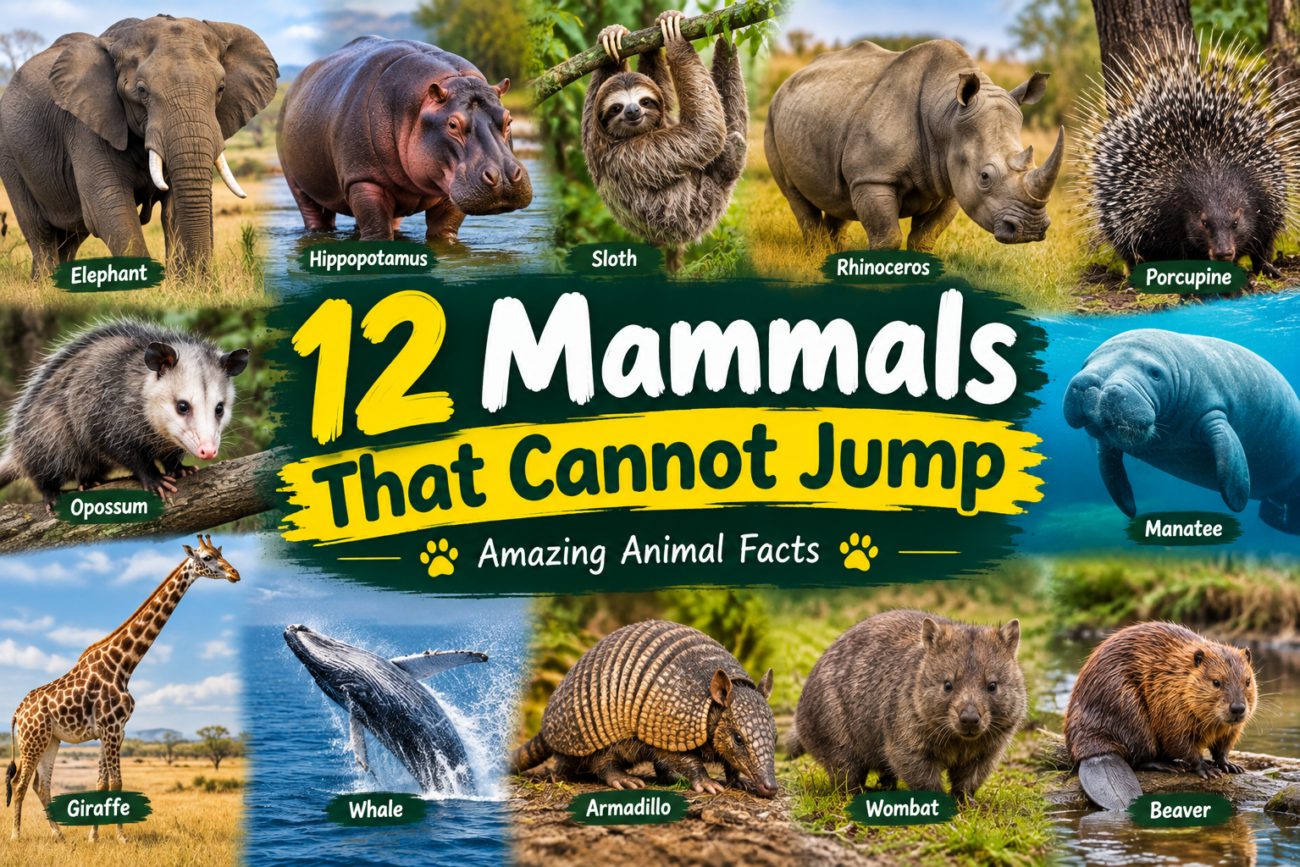
Jumping looks simple, but it requires a surprising combination of strong muscles, flexible joints, balance, and the ability to push the entire body away from the ground. While many mammals can leap, hop, or bound, some are not built for this type of movement.
Mammals that cannot jump include some of the largest and most unusual animals on Earth. Elephants are the classic example, but they are not the only mammals whose normal movement does not involve true jumping. Hippos, rhinoceroses, sloths, manatees, and several other mammals rely on walking, running, climbing, swimming, digging, or other specialized forms of locomotion.
One important point is that “cannot jump” can mean different things. An animal may be physically unable to perform a conventional jump, or it may simply not normally use jumping as part of its natural movement. Whales, for example, can breach dramatically out of the water, but that is different from a terrestrial mammal jumping from land.
This guide explores 12 mammals that cannot jump, why jumping is difficult for them, and how their anatomy and body structure influence the way they move.
What Are Mammals That Cannot Jump?
Mammals that cannot jump are animals that generally cannot perform a conventional jump in which the body is deliberately propelled completely off the ground and then lands again.
Jumping depends on generating enough force to overcome body weight. It also requires appropriate limb joints, muscles, tendons, and balance. Large mammals often have limbs adapted primarily for supporting and moving heavy bodies rather than acting like springs.
Elephants provide the clearest example. The Smithsonian’s National Zoo explains that their legs lack the spring-like structures and muscular arrangement needed to push all four feet off the ground simultaneously.
Quick Answer
Some well-known mammals that do not normally perform conventional jumps include elephants, hippopotamuses, sloths, rhinoceroses, porcupines, opossums, manatees, giraffes, whales, armadillos, wombats, and beavers. However, “cannot jump” should not always be treated as an absolute biological rule. Different species and different definitions of jumping can produce different answers.
List of 12 Mammals That Cannot Jump
| No. | Mammal | Scientific Name | Class | Diet |
| 1 | Elephant | Elephas maximus / Loxodonta spp. | Mammalia | Herbivore |
| 2 | Hippopotamus | Hippopotamus amphibius | Mammalia | Herbivore |
| 3 | Sloth | Bradypus / Choloepus spp. | Mammalia | Herbivore |
| 4 | Rhinoceros | Ceratotherium simum | Mammalia | Herbivore |
| 5 | Porcupine | Erethizon dorsatum | Mammalia | Herbivore |
| 6 | Opossum | Didelphis virginiana | Mammalia | Omnivore |
| 7 | Manatee | Trichechus spp. | Mammalia | Herbivore |
| 8 | Giraffe | Giraffa spp. | Mammalia | Herbivore |
| 9 | Whale | Balaenoptera musculus | Mammalia | Varies by species |
| 10 | Armadillo | Dasypus novemcinctus | Mammalia | Omnivore |
| 11 | Wombat | Vombatus ursinus | Mammalia | Herbivore |
| 12 | Beaver | Castor canadensis | Mammalia | Herbivore |
1. Elephant
Scientific Name: Elephas maximus / Loxodonta spp.
Class: Mammalia
Family: Elephantidae
Diet: Herbivore
Habitat: Savannas, forests, grasslands, and wetlands
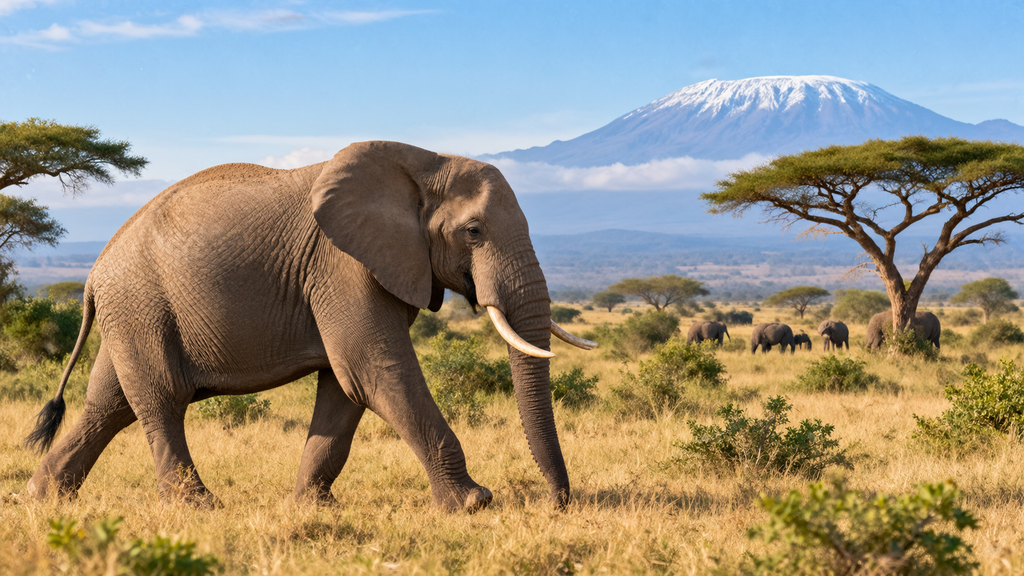
Elephants are the best-known example when people ask, “What mammal cannot jump?” Their enormous body mass and specialized leg structure make a conventional jump impractical. The Smithsonian notes that elephants have relatively vertical limbs designed to support their great weight rather than provide the spring-like action needed for jumping.
Instead of jumping, elephants walk, run, climb slopes, and use their trunks to reach, pull, lift, and manipulate objects. Their thick foot pads also help absorb pressure as they move.
2. Hippopotamus
Scientific Name: Hippopotamus amphibius
Class: Mammalia
Family: Hippopotamidae
Diet: Herbivore
Habitat: Rivers, lakes, wetlands, and surrounding grasslands
The hippopotamus is another massive mammal associated with the list of animals that cannot jump. Despite its powerful body and surprisingly fast movement on land, the hippo is built for walking and running rather than launching its entire body into the air.
Its short legs support a heavy body, while its semi-aquatic lifestyle allows it to spend much of its time in water. Hippos can move through water with remarkable control and can walk along the bottom of deeper areas rather than swimming in the same way as many other mammals.
3. Sloth
Scientific Name: Bradypus spp. / Choloepus spp.
Class: Mammalia
Family: Bradypodidae / Choloepodidae
Diet: Herbivore
Habitat: Tropical forests of Central and South America
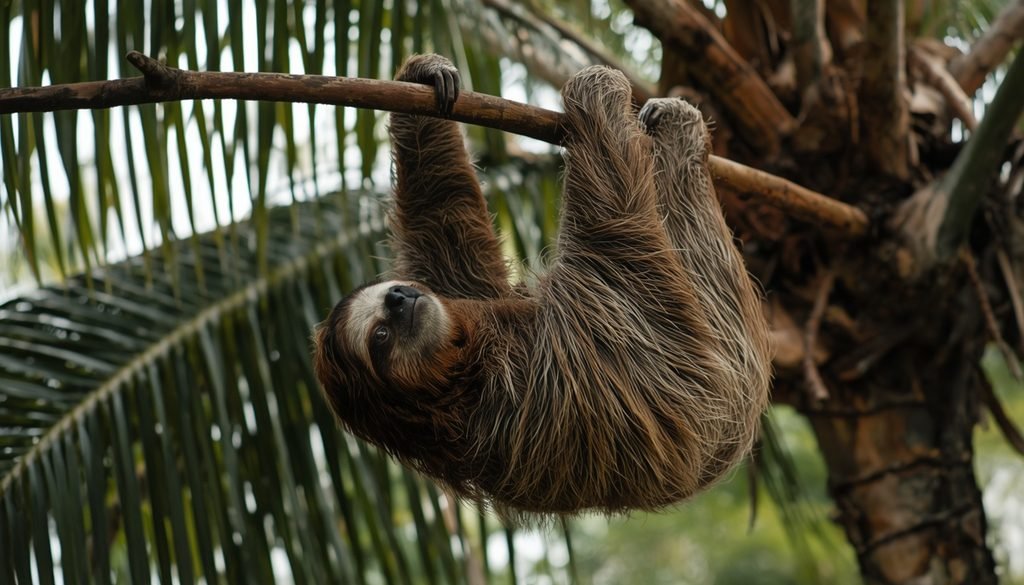
Sloths are famous for slow movement rather than jumping. Their long claws and specialized limbs are adapted for hanging from branches, while their low-energy lifestyle reduces the need for rapid movement.
The Smithsonian explains that sloths have very low metabolic rates and conserve energy because their leafy diets provide relatively little energy. They are also surprisingly capable swimmers despite being awkward on land.
A sloth’s movement is therefore better understood as climbing, hanging, crawling, and swimming rather than jumping.
4. Rhinoceros
Scientific Name: Ceratotherium simum
Class: Mammalia
Family: Rhinocerotidae
Diet: Herbivore
Habitat: Grasslands, savannas, and woodlands
Rhinoceroses have massive bodies supported by sturdy legs. Their feet and limb structure are specialized for carrying weight and moving across rough terrain, not for repeated jumping.
A rhino can run surprisingly quickly despite its size, but running and jumping are mechanically different. During running, an animal can use coordinated strides without deliberately performing a vertical leap.
This is why rhinos are often included among large animals that cannot jump. Their survival strategy depends more on size, speed, horns, and powerful movement than on jumping ability.
5. Porcupine
Scientific Name: Erethizon dorsatum
Class: Mammalia
Family: Erethizontidae
Diet: Herbivore
Habitat: Forests, woodland, and rocky areas
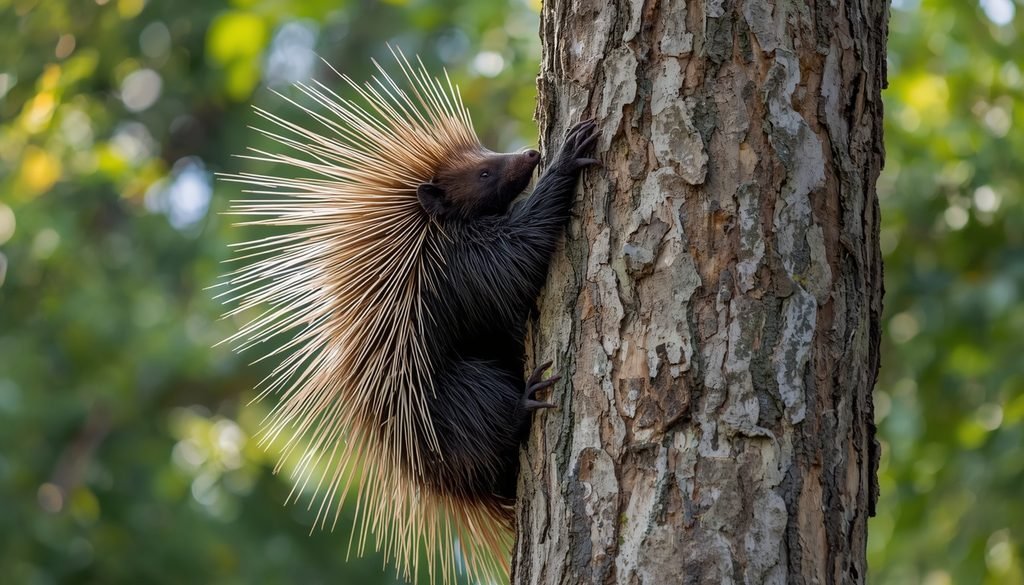
Porcupines are often surprising additions to a list of mammals unable to perform conventional jumps. Their bodies are adapted for climbing, walking, and foraging rather than powerful aerial movement.
North American porcupines are particularly good climbers. Their strong claws help them move through trees, where they can feed on bark, leaves, and other plant material.
Their quills are their best-known defense, allowing them to deter predators without needing to rely on speed or jumping.
6. Opossum
Scientific Name: Didelphis virginiana
Class: Mammalia
Family: Didelphidae
Diet: Omnivore
Habitat: Forests, fields, wetlands, and urban environments
The Virginia opossum is a flexible and adaptable marsupial. It can climb, walk, forage, and move through vegetation, but it is not normally associated with powerful jumping.
Its prehensile tail, grasping feet, and climbing ability are more important to its lifestyle than leaping. Opossums are also famous for their defensive behavior known as playing dead, or tonic immobility.
Because opossums can climb and move through complex habitats, saying that they simply “cannot move upward” would be inaccurate. The better distinction is that jumping is not their characteristic form of locomotion.
7. Manatee
Scientific Name: Trichechus spp.
Class: Mammalia
Family: Trichechidae
Diet: Herbivore
Habitat: Warm coastal waters, rivers, springs, and wetlands
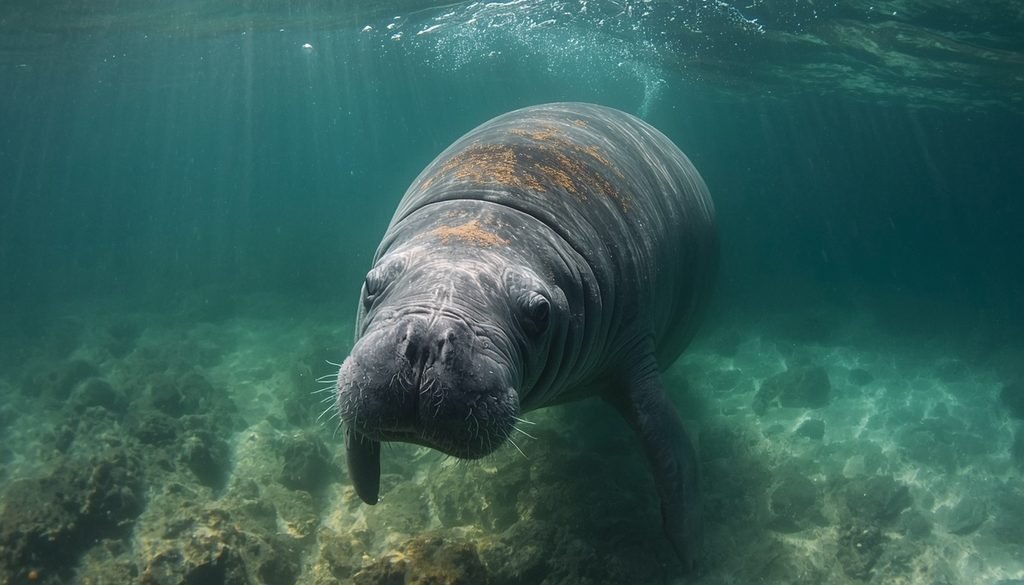
Manatees are fully adapted to aquatic life. Their large bodies, paddle-like foreflippers, and powerful tails allow them to move efficiently through water while feeding on aquatic vegetation.
A manatee is not built for terrestrial jumping. Instead, its locomotion is dominated by swimming and maneuvering underwater.
This makes the manatee a useful example of how habitat influences animal movement. There is little evolutionary advantage in developing a land-jumping ability when an animal spends its life moving through aquatic environments.
8. Giraffe
Scientific Name: Giraffa spp.
Class: Mammalia
Family: Giraffidae
Diet: Herbivore
Habitat: African savannas, grasslands, and woodlands
Giraffes have extremely long legs and necks, giving them a body shape unlike almost any other mammal. Their limbs are highly specialized for walking and running.
Research on giraffe locomotion shows that their long limbs and specialized anatomy influence the mechanical demands of movement.
Giraffes can run with long, coordinated strides, but that should not automatically be confused with a deliberate vertical jump. Their movement is optimized for covering ground efficiently rather than launching their massive bodies upward.
9. Whale
Scientific Name: Balaenoptera musculus
Class: Mammalia
Family: Balaenopteridae
Diet: Mainly krill
Habitat: Oceans worldwide
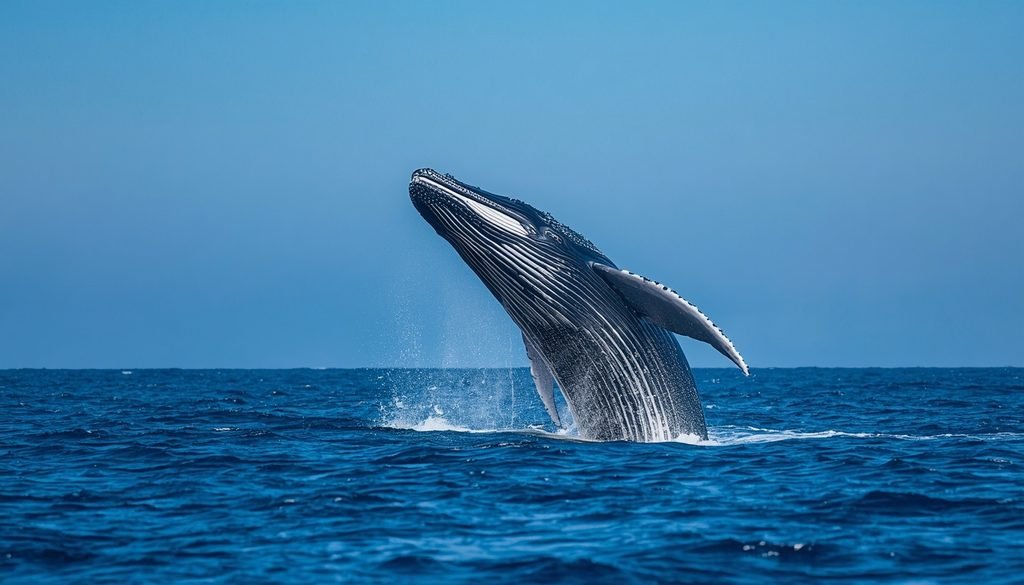
Whales create an interesting problem when discussing mammals that cannot jump because people have seen spectacular images of whales leaving the water.
A whale can breach, sometimes lifting a large portion of its body above the ocean surface. However, breaching is an aquatic behavior and should not be treated as the same thing as a land mammal performing a conventional jump.
Blue whales and other large whales are adapted for swimming, with streamlined bodies, flukes, and powerful muscles that propel them through the ocean.
10. Armadillo
Scientific Name: Dasypus novemcinctus
Class: Mammalia
Family: Dasypodidae
Diet: Omnivore
Habitat: Grasslands, forests, scrublands, and open areas
Armadillos are small to medium-sized mammals protected by a distinctive armored shell. Their short legs and digging adaptations make them much better suited to walking and burrowing than jumping.
The nine-banded armadillo uses strong claws to excavate soil while searching for insects, larvae, and other food. Its body design reflects a lifestyle centered around foraging and digging.
Rather than relying on jumping to escape danger, armadillos can use burrows and their protective armor as important survival tools.
11. Wombat
Scientific Name: Vombatus ursinus
Class: Mammalia
Family: Vombatidae
Diet: Herbivore
Habitat: Grasslands, forests, and shrublands of Australia
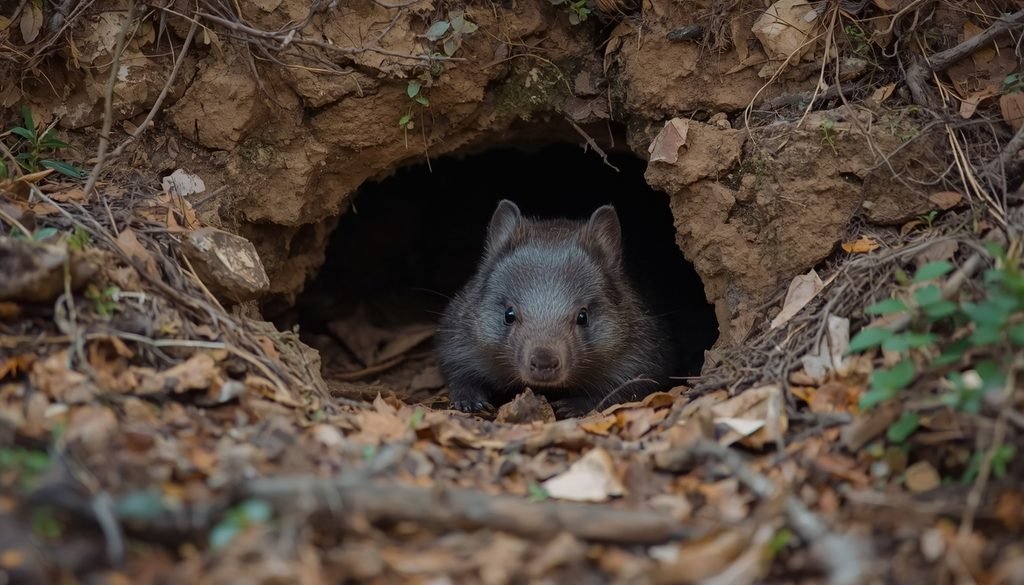
Wombats are compact, muscular marsupials with powerful bodies and short legs. They are famous for digging extensive burrows, making their limbs particularly useful for moving soil.
Their movement is primarily based on walking and running rather than jumping. Their low, sturdy body shape also helps them navigate underground burrows.
Instead of relying on aerial movement, wombats use their strong limbs, digging ability, and compact body as adaptations for their environment.
12. Beaver
Scientific Name: Castor canadensis
Class: Mammalia
Family: Castoridae
Diet: Herbivore
Habitat: Rivers, streams, ponds, and wetlands
Beavers are semi-aquatic rodents famous for building dams and lodges. Their bodies are designed around swimming, diving, cutting vegetation, and moving along riverbanks.
Their large front teeth help them cut woody plants, while their broad tails provide balance and assist with swimming. Jumping is not an important part of their natural movement.
Like other mammals on this list, the beaver demonstrates that animals do not need every type of locomotion to survive. Evolution tends to favor traits that match an animal’s ecological niche.
Why Can Some Mammals Not Jump?
Jumping requires an animal to generate enough force to lift its body completely away from the ground. Several factors influence this ability:
- Body mass: Heavy animals need much more force to become airborne.
- Leg structure: Strong supporting limbs are not always effective spring-like limbs.
- Muscle arrangement: Jumping requires rapid force production.
- Joint flexibility: Flexible joints can help store and release mechanical energy.
- Tendons and ligaments: Elastic tissues can contribute to powerful movement.
- Balance: Large bodies can be difficult to control during aerial movement.
- Habitat: Aquatic, arboreal, and burrowing mammals may have little need for jumping.
Elephants demonstrate the relationship between anatomy and body mass particularly well. Their vertical limb arrangement and dense bones provide support for their enormous weight.
What Makes Jumping Difficult for Large Mammals?
Large mammals face a basic mechanical challenge: the heavier the body, the more force is needed to accelerate it upward.
This does not mean every large mammal is incapable of leaving the ground. Some large mammals can leap or bound. Instead, jumping ability depends on the relationship between body mass, muscle power, limb proportions, joint movement, and the type of locomotion an animal has evolved.
This is why mammal locomotion is more complicated than simply dividing animals into “jumpers” and “non-jumpers.”
Cannot Jump vs. Rarely Jumps
There is an important difference between an animal being physically unable to jump and an animal that rarely or normally does not jump.
Elephants are a strong example of a mammal that cannot perform a conventional jump. The Smithsonian specifically describes their inability to get all four feet off the ground at once through a normal jump.
Other animals require more careful wording. A mammal might lift all four feet during a gallop, leap over an obstacle, breach from water, or perform another movement that looks like jumping without performing a conventional vertical jump.
For SEO and scientific accuracy, it is better to explain these differences than to make an absolute claim about every species.
Comparison of Mammals That Cannot Jump
| Mammal | Main Movement | Key Adaptation |
| Elephant | Walking/running | Heavy supporting limbs |
| Hippopotamus | Walking/running/swimming | Powerful compact body |
| Sloth | Climbing/crawling/swimming | Claws and energy conservation |
| Rhinoceros | Walking/running | Heavy supporting limbs |
| Porcupine | Walking/climbing | Strong claws |
| Opossum | Walking/climbing | Grasping feet and tail |
| Manatee | Swimming | Paddle-like flippers and tail |
| Giraffe | Walking/running | Long specialized limbs |
| Whale | Swimming/breaching | Flukes and streamlined body |
| Armadillo | Walking/digging | Strong digging claws |
| Wombat | Walking/running/digging | Powerful compact limbs |
| Beaver | Swimming/walking | Broad tail and webbed feet |
Why Do Animals Need Different Types of Locomotion?
Animal movement is closely connected to survival. A cheetah needs rapid acceleration, a sloth needs energy-efficient climbing, a whale needs efficient swimming, and an armadillo benefits from digging.
Jumping is only one possible movement strategy.
Evolution does not create one ideal body design for every animal. Instead, skeletal structure, muscles, limbs, body weight, habitat, diet, and predator pressure all influence how mammals move.
That is why the jumping ability of mammals varies so widely across species.
Read More: 18 Scariest Animals in the World
FAQs
What mammals cannot jump?
Several mammals are commonly described as unable to perform a conventional jump, including elephants, hippopotamuses, rhinoceroses, sloths, manatees, and some other large or specialized mammals. The exact list depends on how “jump” is defined. Breaching, galloping, and lifting the feet during certain movements should not automatically be classified as a true jump.
Are elephants the only mammals that cannot jump?
No. Elephants are the most famous example, but they are not the only mammals that do not perform conventional jumps. Several large mammals and highly specialized animals rely on walking, running, climbing, digging, or swimming instead. The claim that elephants are the only mammals that cannot jump is therefore too broad.
Why can’t elephants jump?
Elephants have enormous body mass and specialized vertical limbs designed primarily for weight support. Their leg and foot anatomy does not provide the spring-like action needed to propel all four feet from the ground during a conventional jump. The Smithsonian’s National Zoo specifically notes this anatomical limitation.
Can hippos jump?
Hippos are powerful runners and spend considerable time in water, but they are not known for performing conventional jumps. Their heavy, compact bodies and short legs are better adapted to walking, running, and aquatic movement than deliberately launching the entire body into the air.
Can giraffes jump?
Giraffes are specialized for walking and running with extremely long limbs and necks. Their locomotor anatomy creates particular mechanical demands, and they are not known for conventional vertical jumping. Research on giraffe movement shows that their unusual limb proportions strongly influence locomotion.
Can sloths jump?
Sloths are not built for jumping. Their specialized claws and limbs are adapted for life in trees, while their low-energy metabolism supports slow movement. They can also swim surprisingly well, showing that an animal can be highly capable in one form of locomotion while being poorly suited to another.
Can whales jump?
Whales can breach, which can make it appear as though they are jumping. However, breaching is an aquatic behavior and is mechanically different from a terrestrial mammal performing a conventional jump. A whale’s body is primarily specialized for swimming through the ocean.
What is the largest mammal that cannot jump?
The elephant is the clearest answer when referring to a conventional terrestrial jump. Elephants are extremely large mammals with limb anatomy specialized for supporting their enormous body weight, and the Smithsonian confirms that they cannot perform a conventional jump.
Conclusion
The world of mammals that cannot jump is more interesting than it may first appear. Elephants are the clearest example, but hippos, rhinos, sloths, manatees, armadillos, wombats, and other mammals also demonstrate how specialized animal locomotion can be.
Some depend on strong supporting limbs, some climb, some dig, and others are adapted almost entirely for life in water. Giraffes use specialized long limbs for walking and running, while whales use powerful tails and flukes for swimming.
The key lesson is that an inability to perform a conventional jump is not necessarily a weakness. Each mammal has a body designed around its habitat and survival needs. In nature, efficient movement matters far more than being able to perform every possible type of locomotion.

One thought on “12 Mammals That Cannot Jump: Amazing Animal Facts”