
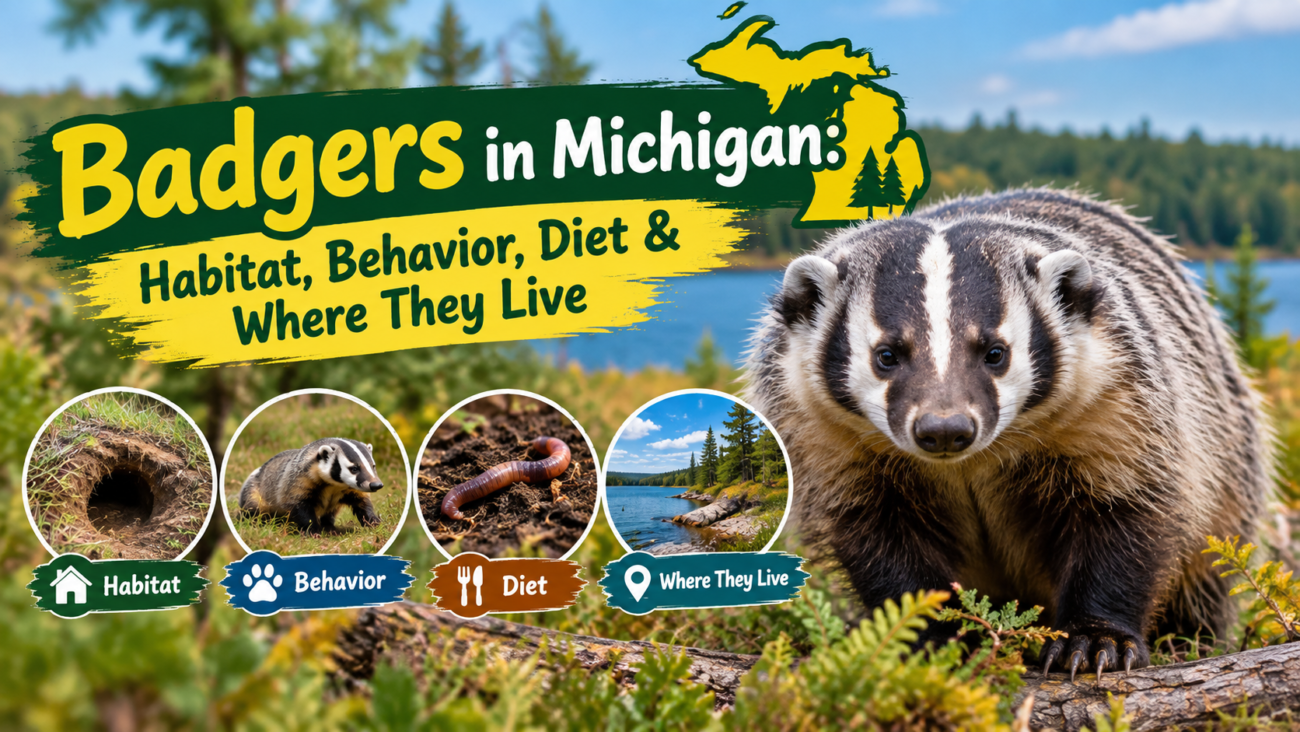
Badgers in Michigan are fascinating burrowing mammals that many people rarely see in the wild. The American badger is built for life on the ground, with powerful front legs, long claws, a low body profile, and strong digging abilities. Unlike animals that spend most of their time in forests or wetlands, badgers are closely associated with open landscapes where they can move across the ground and search for prey.
Michigan is home to American badgers, and the species is included in the state’s furbearer management system. The Michigan Department of Natural Resources provides specific management units, seasons, bag limits, and other regulations for badgers.
But seeing a badger in Michigan can still be an unusual experience. These animals are mostly solitary and can spend considerable time underground or moving through suitable habitat away from busy areas.
This guide explains what Michigan badgers look like, where they live, what they eat, how they behave, how to recognize signs of their presence, and what to do if you encounter one.
Badger at a Glance
| Feature | Information |
| Common Name | American Badger |
| Scientific Name | Taxidea taxus |
| Animal Group | Mammal |
| Family | Mustelidae |
| Order | Carnivora |
| Range | North America |
| Lifestyle | Mostly solitary |
| Main Adaptation | Powerful digging |
| Typical Habitat | Open landscapes with suitable prey and soil |
| Michigan Status | Managed as a furbearer |
The American badger belongs to the Mustelidae family, the same broad family that includes animals such as weasels, otters, martens, and wolverines. It is not a rodent, even though its low body and digging behavior may sometimes remind people of ground-dwelling rodents.
Michigan DNR wildlife materials identify the badger as Taxidea taxus and include it among Michigan’s furbearing animals.
What Do Badgers in Michigan Look Like?
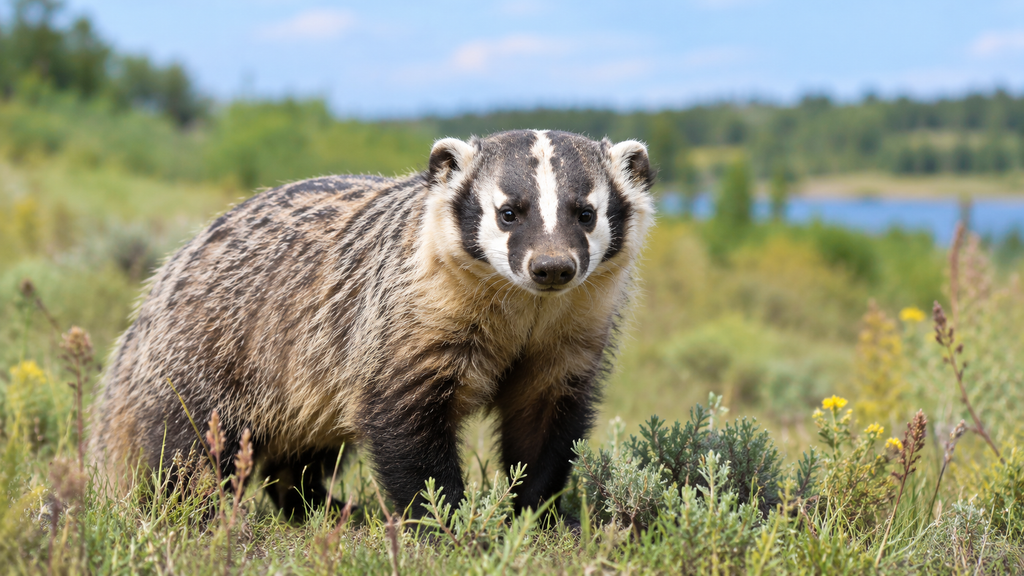
An American badger has a distinctive appearance that makes it easier to recognize once you know what to look for.
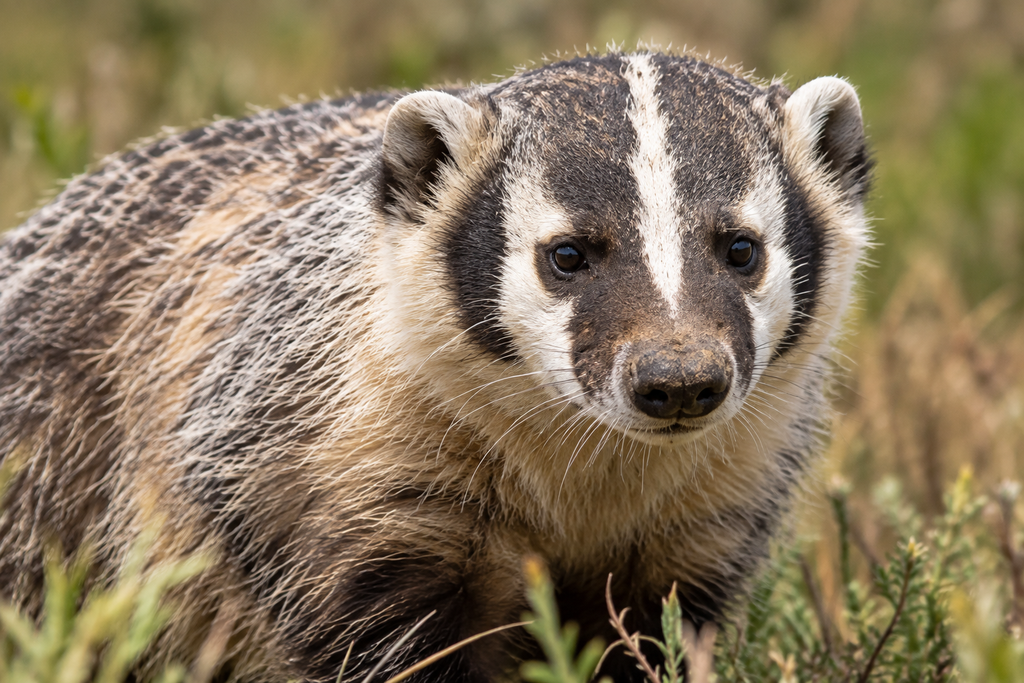
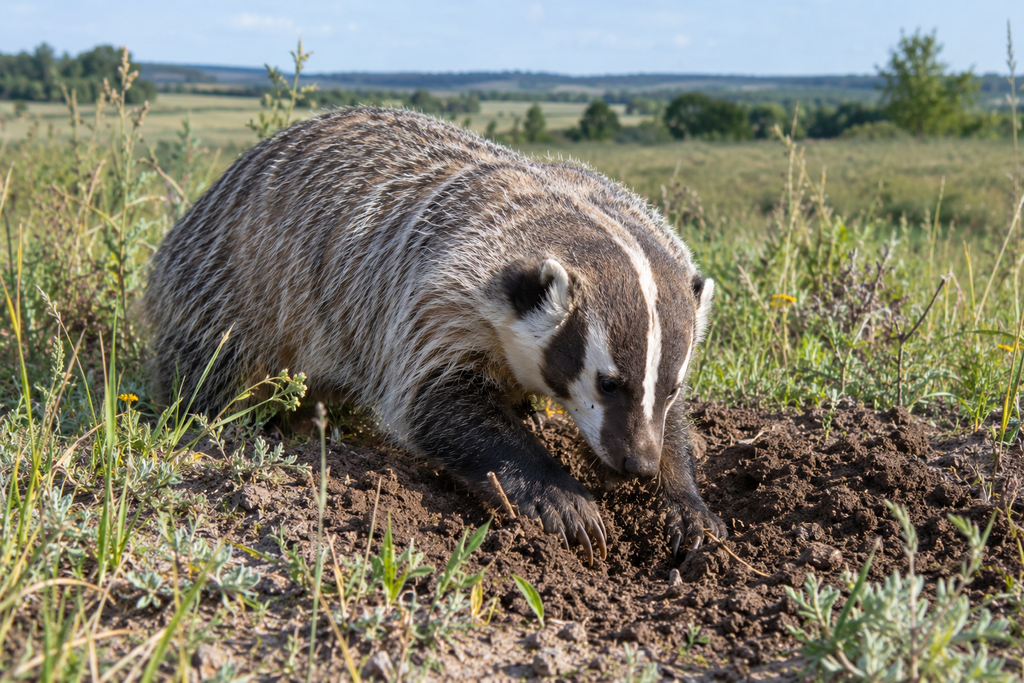
The animal has a relatively low, broad body, short legs, a small head, and strong forelimbs. Its coat generally has a gray, brown, and black appearance, while its face has contrasting markings that give it a recognizable mask-like appearance.
One of the most noticeable features is the pale stripe running along the head and back. Dark markings around the face and eyes create additional contrast.
The badger’s front feet are particularly important. Its long claws and muscular forelimbs help it excavate soil while searching for prey or creating shelter.
Its body shape is also useful for underground movement. A low profile allows the animal to work close to the ground while digging and moving through narrow spaces.
Are There Badgers in Michigan?
Yes, American badgers live in Michigan.
Michigan DNR’s wildlife management information includes badgers among the state’s furbearers, and current regulations provide specific badger management units and harvest rules.
However, that does not mean badgers are equally common everywhere in Michigan. Wildlife distribution depends on habitat, food availability, soil conditions, land use, and other environmental factors.
Badgers can be difficult to spot because they are generally solitary animals and may spend time in underground burrows or move through open areas without attracting much attention.
For someone exploring Michigan’s wildlife, an encounter with an American badger can therefore be a memorable sighting.
Where Do Badgers Live in Michigan?
Badgers are associated with habitats where their hunting and digging lifestyle is possible.
Suitable landscapes can include:
- Open grasslands
- Fields
- Pastures
- Agricultural areas
- Open rural landscapes
- Areas with suitable digging conditions
- Places supporting small mammal prey
Open country can be particularly useful because badgers are ground-oriented hunters. They need enough space to move around and search for prey, while workable soil allows them to dig.
This does not mean every field or pasture contains badgers. Habitat suitability is only one part of the picture.
When discussing specific Michigan counties or exact local populations, readers should rely on current wildlife information rather than assuming that a species occurs equally throughout the state.
Badgers in Northern Michigan
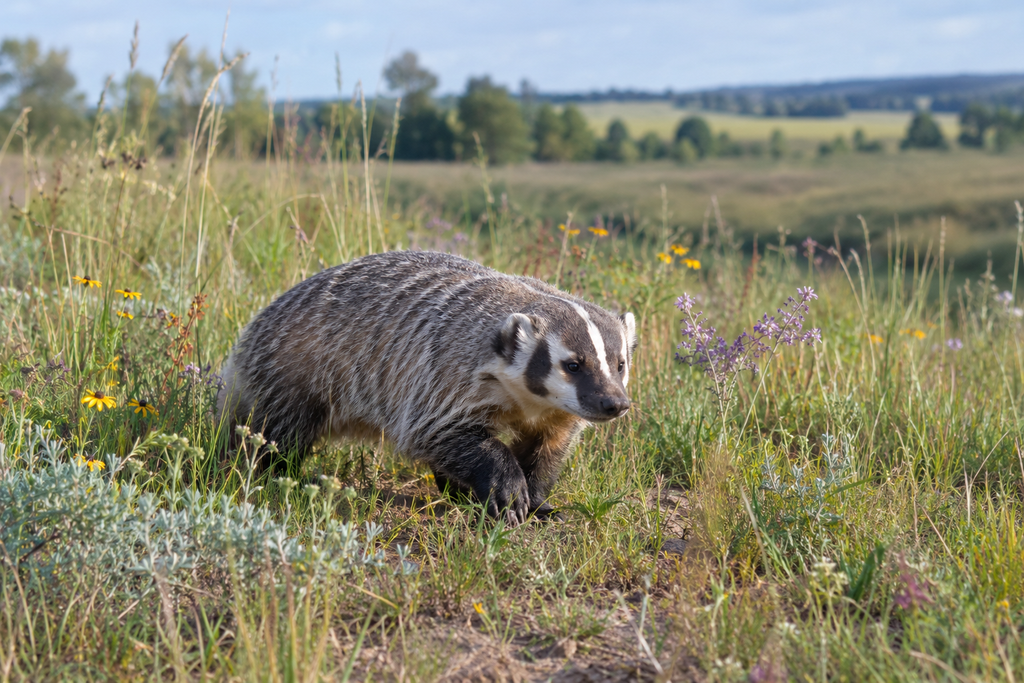
Northern Michigan contains a mixture of forests, wetlands, fields, rural properties, and open landscapes. Badger habitat is more closely connected to suitable open ground than simply to whether an area is classified as northern Michigan.
Rather than looking for badgers in dense forest alone, wildlife observers should think about the combination of open habitat, soil, prey availability, and relatively undisturbed areas.
Specific sightings can vary considerably from one location to another, so a general statement that all northern counties have abundant badgers would be misleading.
Badgers in the Upper Peninsula
The Upper Peninsula is included within Michigan’s badger management framework. In the current 2026 regulations, Badger Management Zone 1 includes Baraga, Dickinson, Gogebic, Houghton, Iron, Keweenaw, Marquette, Menominee, and Ontonagon counties, plus specified portions of Alger and Delta counties. Zones 2 and 3 correspond with Michigan’s hunting zones.
These management boundaries are primarily regulatory rather than a simple map of where every badger lives.
If you are researching badgers in the Upper Peninsula, use the current Michigan DNR boundaries and wildlife information rather than relying on older maps or informal sightings.
Badgers in the Lower Peninsula
Badgers are also part of Michigan’s statewide wildlife management framework, but their presence should not be interpreted as uniform across every part of the Lower Peninsula.
Open rural landscapes may provide more suitable conditions than heavily developed areas because badgers need appropriate habitat for movement, hunting, and digging.
Anyone trying to understand local badger distribution should distinguish between statewide species presence and local abundance. These are not the same thing.
Why Are Badgers Such Good Diggers?
Digging is one of the most important features of American badger behavior.
A badger’s body is designed for working through soil. Its front legs are powerful, while the long claws help loosen and move dirt.
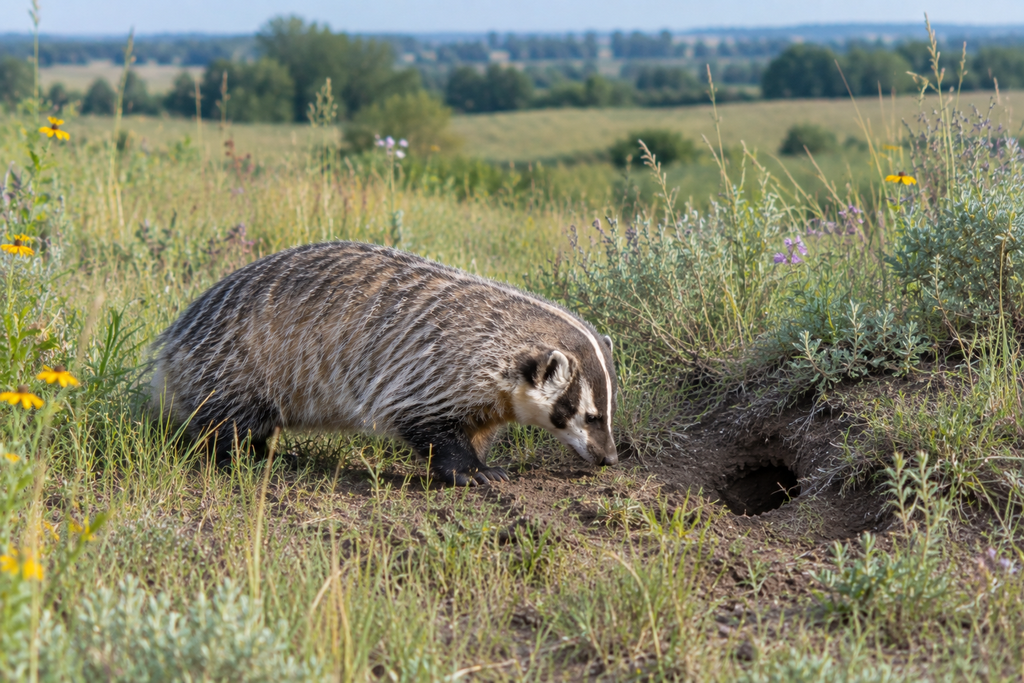
Badgers may dig while hunting underground prey, creating shelter, or using an existing area for protection.
Their digging behavior can also leave obvious changes in the ground. Freshly disturbed soil, holes, and piles of excavated dirt may sometimes indicate animal activity.
However, a hole by itself is not enough to identify a badger. Other mammals also dig or use underground burrows.
What Do Badgers Eat in Michigan?
American badgers are carnivorous predators that are well adapted to hunting animals found close to the ground or underground.
Their diet can include small mammals such as:
- Ground squirrels
- Mice
- Voles
- Other small mammals
- Various available prey species
- Insects and other smaller food items when available
Their digging ability is especially useful when searching for prey that lives underground.
Food availability changes with habitat and season, so a badger’s exact diet can vary from one location to another.
This connection between hunting and digging explains why badgers are often associated with open ground where small mammals are present.
When Are Badgers Active?
Badger activity can vary according to season, weather, temperature, prey availability, and local conditions.
They are not animals that follow a perfectly predictable schedule in every location. Their behavior can change depending on environmental conditions and whether they are hunting, traveling, or using a den.
During warmer periods, a badger may spend time moving across open terrain in search of food. During colder conditions, activity patterns can change.
Because badgers may spend time underground, seeing one requires both suitable habitat and good timing.
Badger Burrows and Dens
Burrows are an important part of badger ecology.
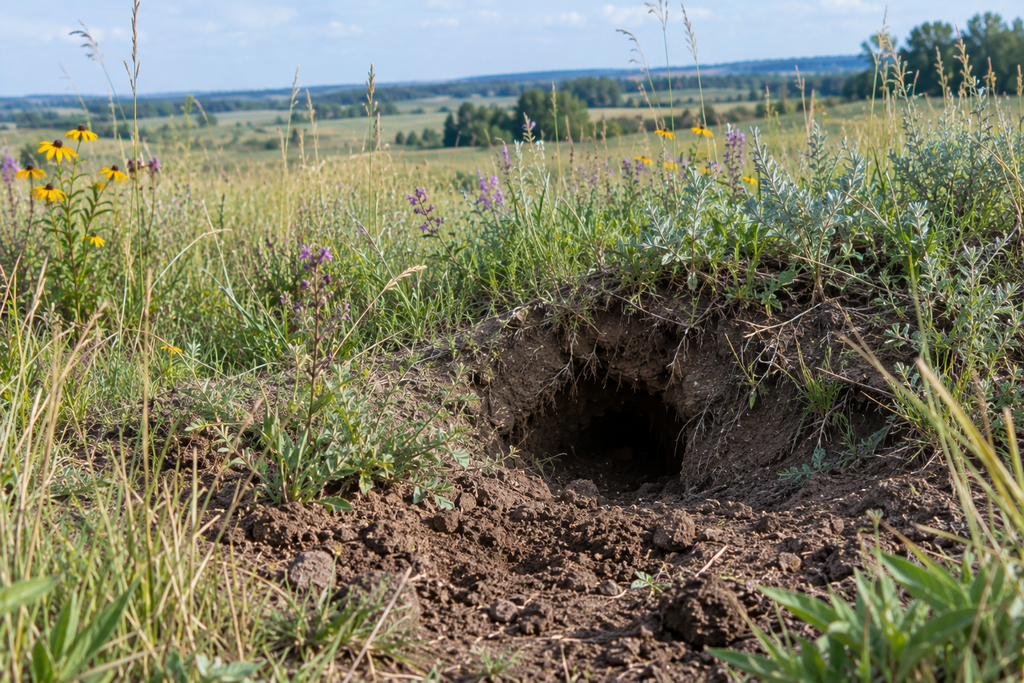
A badger may excavate soil while hunting or create underground shelter. Some excavations may be temporary hunting holes rather than permanent homes.
Signs of possible badger activity can include:
- Freshly disturbed soil
- Large digging marks
- Open holes
- Scraped ground
- Soil piles near an excavation
- Tracks near a burrow
Still, identification requires caution.
Many mammals use holes and burrows, and an abandoned excavation can remain visible long after the animal that created it has left.
Michigan’s current regulations also specifically address animal structures and prohibit setting traps inside the internal compartment of a badger burrow or den.
Badger Behavior in Michigan
American badgers are generally solitary animals.
Their behavior is strongly influenced by survival needs rather than social group living. Much of their time is spent searching for food, moving through suitable habitat, digging, or resting.
Important behaviors include:
- Digging
- Hunting
- Foraging
- Moving across open terrain
- Using underground shelter
- Remaining alert to threats
- Defending themselves when necessary
A wild badger should always be treated as a wild predator.
Even if the animal appears calm, approaching it closely can cause unnecessary stress and create a dangerous situation for both the person and the animal.
Are Badgers in Michigan Dangerous?
Badgers are powerful wild mammals, but that does not mean they automatically pose a threat to people.
A wild badger will generally benefit from having space. Problems are more likely when a wild animal is cornered, handled, chased, or otherwise threatened.
Badgers have strong jaws and sharp claws, so they should never be treated like a tame animal.
If you encounter one:
- Stay several yards away
- Do not approach it
- Do not try to touch it
- Do not feed it
- Keep dogs under control
- Give it a clear escape route
- Watch quietly from a safe location
The safest wildlife encounter is one in which the animal can continue its normal behavior without interference.
What Should You Do If You See a Badger in Michigan?
Seeing a badger can be exciting, especially because many people rarely encounter one.
The best response is simple: observe without interfering.
Use binoculars or a camera with a zoom lens rather than walking toward the animal. If you are hiking with a dog, keep the dog under control and prevent it from chasing the badger.
Do not block the animal’s path or approach a suspected den.
If an animal appears injured, trapped, or involved in an unusual human-wildlife conflict, contact the appropriate local wildlife authority rather than attempting a rescue yourself.
How to Identify a Badger in Michigan
A combination of physical characteristics can help distinguish an American badger from other mammals.
Look for:
- A low body close to the ground
- Short legs
- A broad, muscular appearance
- Gray-brown fur
- Dark facial markings
- A lighter stripe along the head and back
- Large front claws
- A relatively short tail
- Strong digging behavior
- Movement across open ground
Distance can make identification difficult. A badger seen briefly at dusk may look very different from one photographed in good daylight.
When identification matters, use several characteristics rather than relying on one feature.
Badger Tracks and Other Signs
Tracks can provide useful clues, but they should not be used alone.
Possible badger signs include:
- Footprints
- Digging
- Burrows
- Scraped soil
- Excavated prey areas
- Fur
- Droppings
- Repeated activity around suitable habitat
The presence of a burrow is not proof that a badger currently occupies it.
Wildlife signs change over time, and different species can create similar-looking holes or tracks.
Badger vs Groundhog
Badgers and groundhogs can sometimes be confused because both are capable of digging underground shelters.
However, they are very different animals.
| Feature | Badger | Groundhog |
| Animal group | Mammal | Mammal |
| Family | Mustelidae | Sciuridae |
| Order | Carnivora | Rodentia |
| Diet | Primarily animal prey | Primarily plant material |
| Body shape | Low and muscular | Chunkier and rodent-like |
| Front claws | Large digging claws | Strong digging claws |
| Hunting behavior | Predator | Primarily herbivorous |
| Relationship to rodents | Not a rodent | Rodent |
A groundhog is a member of the squirrel family, while the American badger belongs to the weasel family.
The two species may share some digging-related behaviors, but their biology and lifestyles are quite different.
Badger vs Wolverine
Badgers and wolverines both belong to the mustelid family, but they are not the same animal.
A wolverine is substantially different in size, appearance, habitat preferences, and geographic distribution.
The American badger is particularly adapted to digging and open-country hunting. Wolverines are associated with much more northern and remote environments.
Because both animals can have dark facial markings and powerful bodies, photographs taken from a distance can sometimes cause confusion.
The safest way to identify one is to consider body shape, habitat, behavior, and geographic context together.
Badger vs Skunk
Badgers and skunks are sometimes confused because both are ground-dwelling mammals with contrasting dark and light coloration.
Their behavior, however, is quite different.
Skunks are famous for their defensive spray, while badgers rely more heavily on physical defenses and their powerful claws and jaws.
Badgers also have a more muscular, low-slung appearance and are strongly associated with digging and hunting.
If you see a striped black-and-white animal with a raised tail, you are much more likely to be looking at a skunk than a badger.
Badger vs Raccoon
Raccoons are generally easy to distinguish from badgers when seen clearly.
Raccoons have:
- Ringed tails
- Mask-like facial markings
- More upright bodies
- Dexterous front paws
- Strong climbing ability
Badgers have:
- Short legs
- Low bodies
- Powerful forelimbs
- Large digging claws
- Different facial markings
- Strong burrowing behavior
Their diets can overlap in some circumstances, but their physical adaptations and lifestyles are quite different.
Are Badgers Protected or Regulated in Michigan?
Michigan manages badgers under its furbearer regulations.
The Michigan DNR’s current 2026 Furbearer Harvest Regulations Summary includes specific badger management units, seasons, licensing requirements, and bag limits. The current rules apply through April 30, 2027.
The current regulations list a resident badger bag limit of one, with no nonresident bag limit listed because nonresident participation is not listed for badger in that table.
Michigan’s badger management areas include three zones. Zone 1 has a specifically listed group of Upper Peninsula counties and portions of Alger and Delta counties, while Zones 2 and 3 correspond to Michigan’s hunting zones.
Regulations can change, so anyone interested in legal harvest should check the latest Michigan DNR rules before taking action.
For general wildlife observation, the regulations are still worth understanding because they show that badgers are part of Michigan’s formal wildlife management system.
Badgers and Michigan Wildlife Management
Michigan’s Department of Natural Resources uses wildlife management tools to monitor and regulate furbearer species.
The state’s fur harvester information identifies badger as one of the species managed through Michigan’s furbearer system. DNR reports and harvest information are used as part of wildlife management and regulation decisions.
This is important because wildlife management is not simply about counting animals. Agencies may consider harvest information, regulations, habitat, management zones, and other indicators when making decisions.
Readers should therefore avoid using a single photograph or isolated sighting as evidence that badger populations are increasing or decreasing.
Why Are Badgers Important to Michigan’s Ecosystem?
Badgers are predators, and predators play important roles in food webs.
By hunting small mammals and other prey, badgers participate in the natural balance of grassland and open-land ecosystems.
Their digging behavior can also disturb soil and create changes in the ground surface.
Most importantly, badgers are part of Michigan’s native wildlife community. Understanding their behavior helps people appreciate why different habitats support different types of wildlife.
Healthy ecosystems are rarely defined by one species alone. They depend on relationships among predators, prey, plants, soil, and habitat.
10 Interesting Facts About Badgers in Michigan
1. Badgers Are Not Rodents
Despite their digging lifestyle, American badgers are carnivorous mammals in the weasel family.
2. Their Front Claws Are Powerful
Long claws help badgers excavate soil while hunting and creating shelter.
3. Badgers Can Hunt Underground
Their digging ability allows them to pursue prey that other predators may have difficulty reaching.
4. They Are Mostly Solitary
American badgers generally do not live in large social colonies.
5. Open Habitat Matters
Badgers are associated with open landscapes where they can hunt and move efficiently.
6. A Burrow Does Not Always Mean a Permanent Den
Some excavations are connected with hunting rather than long-term shelter.
7. Badgers Are Managed in Michigan
Michigan DNR includes badgers within its furbearer management regulations.
8. Badgers Have Distinctive Facial Markings
Their contrasting facial pattern is one of their most recognizable features.
9. Badgers Can Be Difficult to Spot
Their solitary lifestyle and use of underground shelter can make encounters uncommon.
10. Wildlife Observation Should Be Non-Intrusive
The best way to watch a badger is from a safe distance without feeding, chasing, or approaching it.
Common Misconceptions About Michigan Badgers
Badgers Are Rodents
They are not. American badgers belong to the mustelid family.
Every Large Hole Is a Badger Burrow
Not necessarily. Many mammals dig or use underground holes.
Badgers Are Always Aggressive
A wild badger can defend itself, but that does not mean every encounter is an attack.
Badgers Are the Same as Wolverines
They are related through the mustelid family but are distinct species with different characteristics.
A Badger Sighting Means the Area Has Many Badgers
One sighting only proves that a badger was observed there. It does not establish population density.
Badger Photography in Michigan
Wildlife photographers should prioritize the animal’s welfare over getting a close photograph.
A telephoto lens is usually more appropriate than approaching a badger on foot. Give the animal plenty of space and avoid blocking its movement.
Never deliberately chase a badger into a more visible position for a photograph.
It is also important to avoid disturbing suspected dens, particularly when young animals may be present.
For photographers working on private property, permission from the landowner is also essential.
How to Find Badgers in Michigan Responsibly
If your goal is wildlife observation, focus on habitat rather than chasing individual animals.
Look for broad areas of suitable open terrain and pay attention to signs such as disturbed soil or possible burrows.
Early planning is useful because wildlife encounters depend heavily on timing and conditions.
A responsible observer should:
- Stay on permitted land
- Respect private property
- Keep distance from wildlife
- Avoid disturbing dens
- Keep dogs under control
- Follow park rules
- Avoid feeding wild animals
- Leave natural habitat undisturbed
The objective should be to observe wildlife, not force an encounter.
Where to Learn More About Badgers in Michigan
For Michigan-specific information, the Michigan Department of Natural Resources is the most important starting point.
Its resources include:
- Furbearer regulations
- Management units
- Hunting and trapping information
- Wildlife management information
- Wildlife conservation orders
- Current regulations and updates
Michigan DNR explains that its regulation summaries are condensed versions of the broader Wildlife Conservation Order, which contains the full legal descriptions and regulations.
For current legal information, always consult the latest DNR publication rather than relying on an old article or social media post.
Badgers in Michigan vs Other Wildlife
| Animal | Family | Main Lifestyle | Key Feature |
| American Badger | Mustelidae | Predatory, burrowing | Powerful digging |
| Groundhog | Sciuridae | Herbivorous, burrowing | Large rodent |
| Wolverine | Mustelidae | Solitary predator | Larger, powerful mustelid |
| Skunk | Mephitidae | Omnivorous | Defensive spray |
| Raccoon | Procyonidae | Omnivorous | Ringed tail and climbing |
| Fox | Canidae | Predatory | Long-legged runner |
This comparison shows why identifying a wild animal from one characteristic can be misleading.
A low body might suggest a badger, but habitat, facial markings, tracks, behavior, and movement should all be considered.
Read More: Animals Like Hamsters
FAQs
Are there badgers in Michigan?
Yes. American badgers (Taxidea taxus) occur in Michigan and are included in the state’s furbearer management system. Michigan DNR publishes specific regulations and management units for the species. Their distribution should not be assumed to be uniform throughout the state because suitable habitat, food availability, and local environmental conditions vary.
Where do badgers live in Michigan?
Badgers are associated with open habitats where they can hunt and dig, including grasslands, fields, pastures, and some agricultural landscapes. Suitable soil and prey availability are also important. A specific field or county should not automatically be considered badger habitat simply because it looks open.
What do Michigan badgers eat?
American badgers primarily prey on animals such as small mammals, including mice, voles, and ground squirrels. Their strong digging ability helps them investigate underground prey. Their exact diet can vary according to local habitat and which prey are available.
Are Michigan badgers dangerous?
Badgers are wild predators with powerful claws and jaws, so they should be treated with caution. They are not automatically aggressive toward people. The safest approach is to maintain distance, avoid cornering or chasing the animal, and keep pets away.
Do badgers dig burrows?
Yes. Digging is one of the most important behaviors associated with American badgers. They can excavate soil while hunting and may also use underground spaces for shelter. However, not every hole found in Michigan is necessarily a badger burrow.
Are badgers related to wolverines?
Yes. Both American badgers and wolverines belong to the mustelid family, but they are different species with different body sizes, habitats, behaviors, and geographic patterns. They should not be treated as the same animal simply because they are related.
Can I trap a badger in Michigan?
Michigan regulates badger harvest through its furbearer rules. The current 2026 regulations specify badger management units, seasons, licensing requirements, and a resident bag limit of one. Regulations can change, so anyone considering trapping should check the latest Michigan DNR rules before acting.
What should I do if I see a badger in Michigan?
Observe it from a safe distance and do not approach, feed, chase, or attempt to touch it. Keep dogs under control and give the animal a clear route away from you. If the animal appears injured or is involved in an unusual wildlife conflict, contact an appropriate wildlife authority.
Final Thoughts
Badgers in Michigan are distinctive members of the state’s wildlife community. Their low bodies, powerful claws, facial markings, solitary behavior, and impressive digging abilities make them very different from the rodents and other mammals they may sometimes be confused with.
Michigan badgers are associated with suitable open habitats where they can hunt and dig. Their presence is also recognized within Michigan’s formal furbearer management system, which includes specific management units and regulations.
If you are lucky enough to see one, the best approach is simple: keep your distance, observe quietly, and allow the animal to continue its natural behavior.
For anyone interested in Michigan wildlife, learning to recognize the American badger is a good reminder that some of the state’s most interesting mammals are not always the easiest to spot.

One thought on “Badgers in Michigan: Habitat, Behavior, Diet & Where They Live”